Chocolate Bar Packaging for Small Brands: Wrapper, Sleeve or Folding Carton?
Quick answer: Start with a sealed inner wrapper specified for the chocolate and its intended conditions of use. Then choose the printed outer pack. A paperboard band or sleeve keeps the wrapped bar visible and uses less board; a folding carton gives it full printed coverage; a rigid box is usually a presentation choice for gift sets, not a substitute for the food-contact wrapper. If you are comparing suppliers, send the dimensions of the finished wrapped bar, not only the chocolate mould.
This guide is for growing chocolate brands and packaging buyers ordering custom secondary packaging. YiHongBox makes custom paper boxes and sleeves in China, with a standard production minimum of 1,000 units per size and design. If you need a direct-food-contact film or foil, specify and validate that component with a qualified food-packaging supplier. For the broader category, see our custom chocolate packaging options.
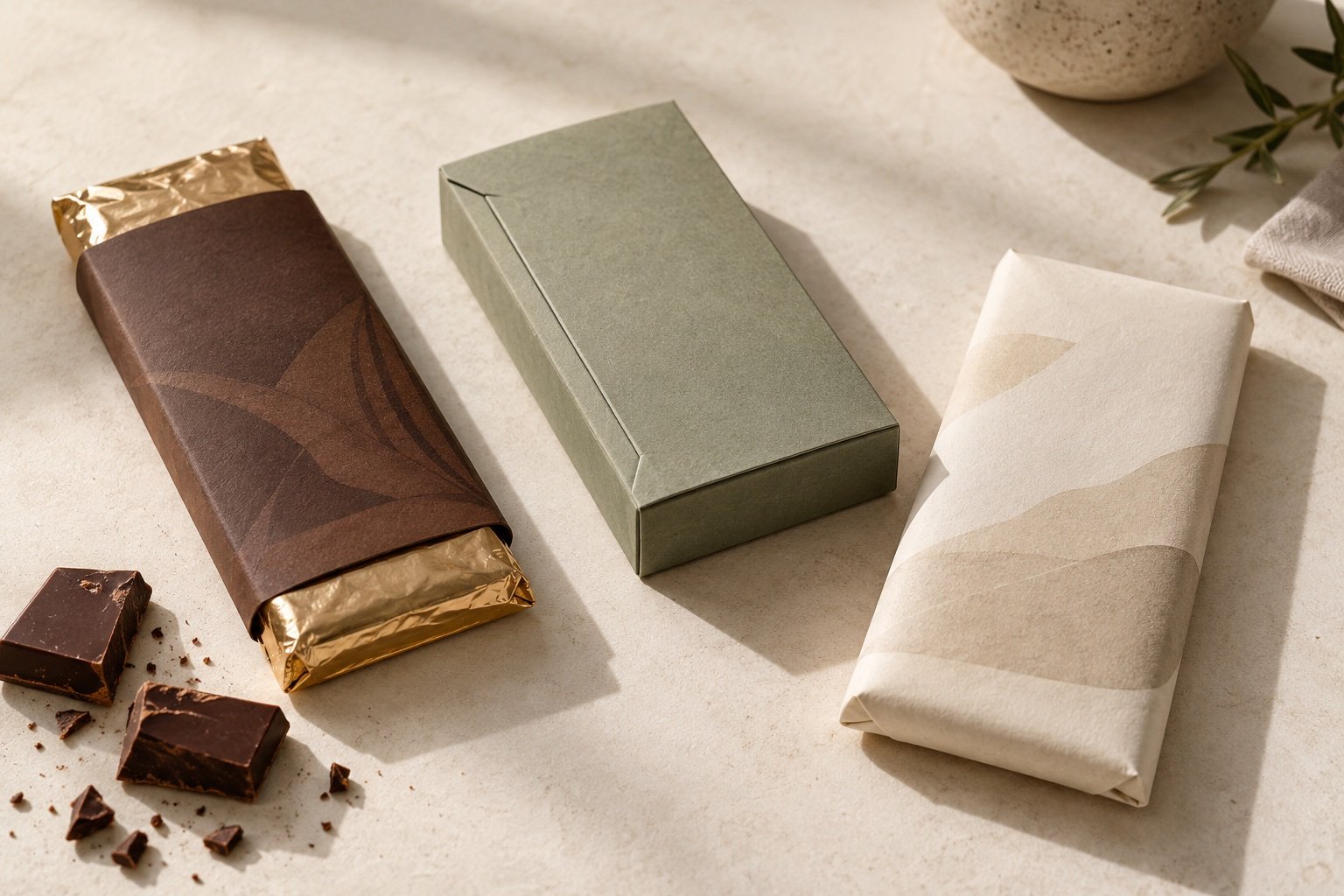
First, separate the three packaging jobs
Buyers often ask whether a sleeve or carton will “protect the chocolate.” That question combines three different jobs. Dividing them before requesting a quote prevents an attractive outer box from being mistaken for a tested barrier or a parcel shipper.
| Layer | Main job | What to verify |
|---|---|---|
| Primary wrap | Touches or closely surrounds the bar and supports the food-protection plan. | Material suitability for the food and conditions of use, seal performance, shelf-life validation and artwork compliance. |
| Retail outer pack | Presents the brand, carries permitted information and helps the wrapped bar hold its intended retail form. | Fit around the wrapped bar, panel space, fold or sleeve retention, print finish and scuff resistance. |
| Shipping pack | Holds the sale unit during transport and fulfilment. | Distribution route, cushioning, movement, heat exposure and packing method. |
These are functional roles, not automatic regulatory classifications. In the US, the FDA explains that food-contact substances can include packaging components such as adhesives and colorants. Health Canada places responsibility for the safety of food packaging on the food seller. Food Standards Australia New Zealand advises businesses to check intended use, including direct or indirect food contact. Have your food-compliance team confirm the materials and label for each destination. This article is a packaging-selection guide, not a certification or legal opinion.
Sleeve, folding carton or rigid box: which outer format fits?
The right answer follows the wrapped bar, sales channel and desired presentation. No format is universally cheaper or more sustainable: board area, printing, finishing, packing labour and freight all change the comparison.
| Format | Best use | Buyer advantage | Limit to plan around |
|---|---|---|---|
| Paperboard band or sleeve | Already sealed single bars where the wrapper may remain visible. | Compact branding layer and straightforward flavour differentiation. | Open ends expose the inner wrap; fit and retention need sampling. |
| Folding carton | Single bars needing a complete printed retail face and enclosed edges. | More panel space for brand and approved product information; normally delivered flat. | More board and assembly than a band; it does not replace the inner barrier or a shipper. |
| Rigid presentation box | Multi-bar gifts, launches and curated assortments. | Substantial presentation and room for a fitted tray or dividers. | Bulkier storage and freight; often excessive for an everyday single bar. |
Choose a sleeve when the sealed bar should stay visible
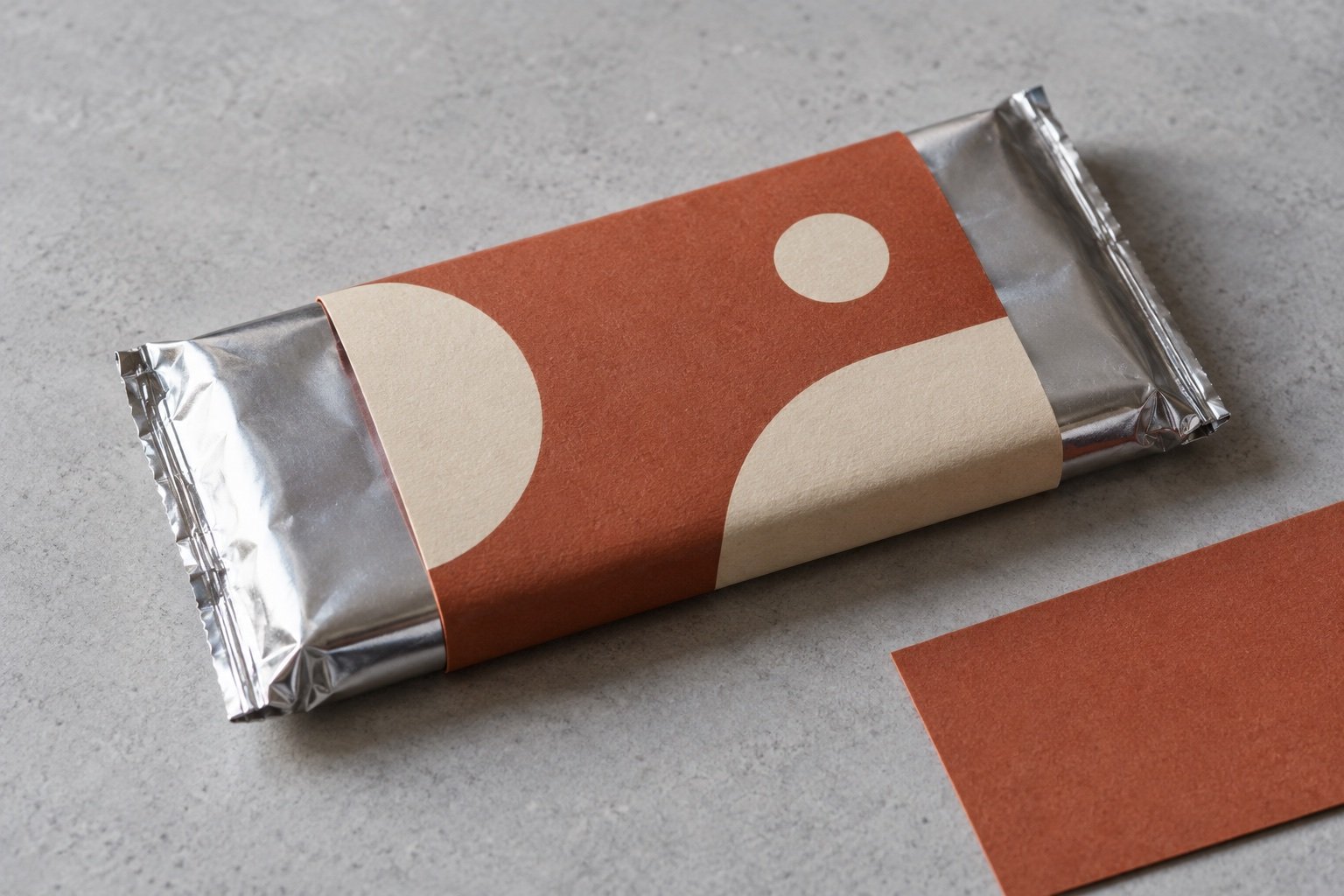
A true open-ended sleeve is a band around the wrapped product, not a carton with tuck flaps. It suits a bar whose inner wrap already provides the necessary food-contact and barrier functions. Because the sleeve exposes the wrapped ends, it is not a substitute for a fully enclosed retail carton when the display brief requires full coverage.
For a useful sample, check band tension on the real wrapped bar, especially at the crimped seals. A loose sleeve can drift; an overly tight one can wrinkle the inner wrap or slow packing. Where different flavours share the same bar geometry, artwork can vary while the structure stays consistent, but each size and printed design still needs its own quantity and quotation. Explore our custom packaging sleeves for the format itself.
Choose a folding carton when the whole sale unit needs a printed box
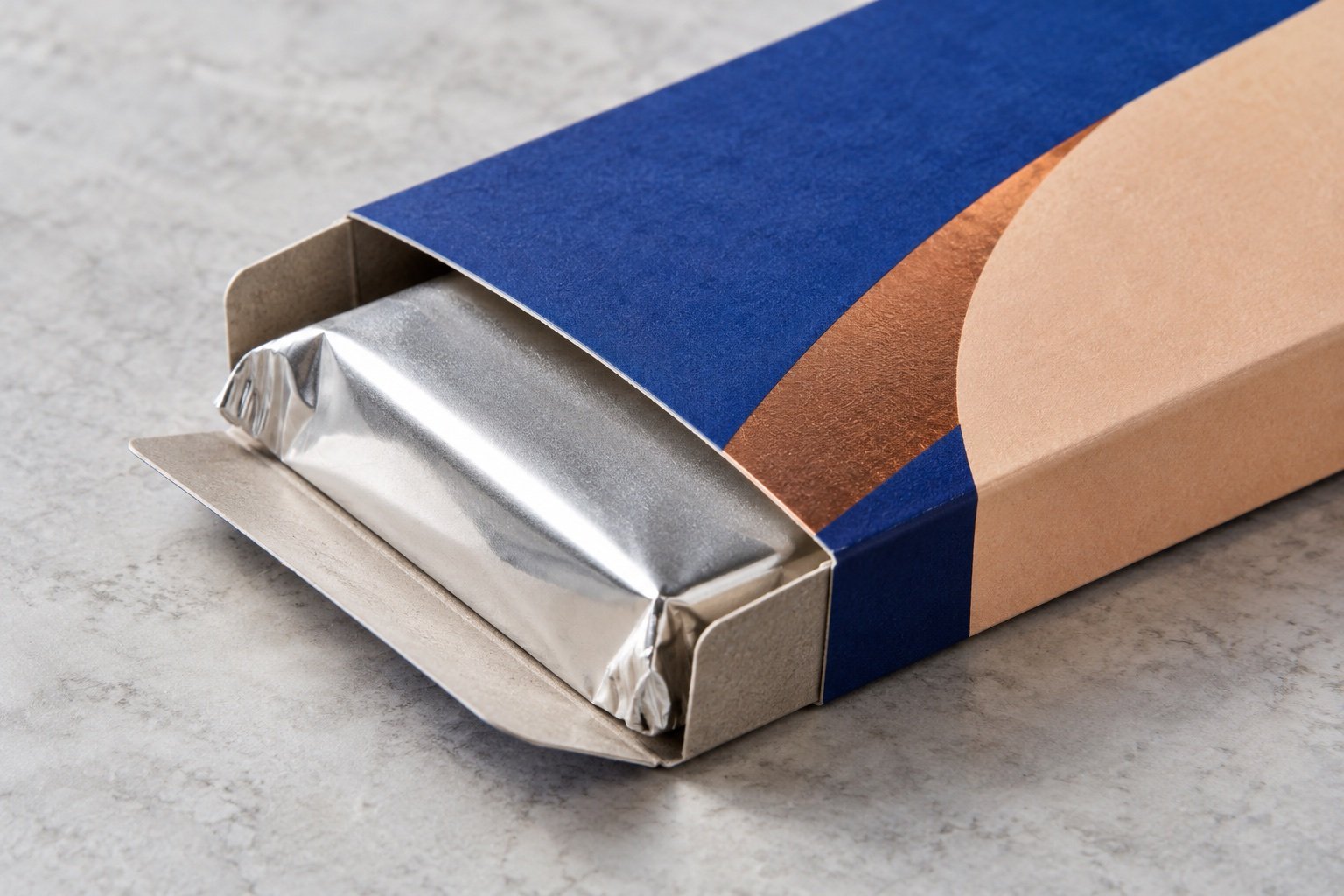
A folding carton encloses the bar and offers more continuous surfaces for artwork and information. It is a strong starting point for a retail range with consistent shelf-facing dimensions or a bar whose inner wrapper is visually plain. Its flat-packed supply can also simplify storage before filling, although packing time and the chosen closing style belong in the cost calculation.
Give the carton manufacturer the finished wrapped bar’s maximum length, width and thickness, including sealed or crimped ends. A mould-size specification alone can produce a box that is too tight at the closure. Decide whether the bar should slide freely, be lightly restrained by a paperboard feature, or sit in a separate insert. Our custom folding carton boxes page shows the broader structure options.
Reserve rigid boxes for a real gift or assortment brief
Rigid boxes can make sense for several individually wrapped bars, seasonal gifts or a premium tasting set. The insert or divider should restrain each wrapped item without making removal awkward. But a rigid box is assembled, occupies more storage volume and adds material. Ask whether that presentation earns its place in the actual retail offer before specifying it for a single everyday bar. For this route, compare custom gift boxes and the simpler custom candy-box formats.
What current US sales data can, and cannot, tell a packaging buyer
The National Confectioners Association’s 2026 State of Treating release reports US confectionery sales of $55 billion in 2025. It says chocolate represented 51.7% of confectionery sales, and Valentine’s Day, Easter, Halloween and the winter holidays together accounted for 63% of all confectionery sales. These are US confectionery-category figures, not demand forecasts for your bar or performance data for any package design.
63% four major candy seasons | 37% other occasions (calculated remainder)
Source: National Confectioners Association, 2026 State of Treating release, reporting 2025 US confectionery sales. This chart is category context, not a chocolate-bar packaging forecast.
For packaging procurement, the practical implication is a planning question: will seasonal artwork, gift assortments or retailer dates require separate specifications? If so, settle the shared box dimensions early and quote each artwork version explicitly. Do not infer from category seasonality that an untested sleeve or carton will increase your sales.
Compare quotes on landed cost, not a headline unit price
Ask every supplier to quote against the same specification. A lower per-box figure may exclude tooling, samples, inserts, packing, freight or destination charges. Conversely, a highly finished carton can cost more than a simple band without delivering value if the retail channel never shows its extra panels.
- Structure and dimensions: Wrapped-bar size, band width, carton closing style and any insert or divider.
- Materials and print: Board, surface texture, ink coverage and approved colour reference.
- Finishes: Foil, embossing, coatings and any window or special die-cut, each priced separately.
- Order mix: Quantity per size and artwork. Do not combine flavours into a single MOQ unless the quotation explicitly allows it.
- Delivery scope: Carton packing method, ship-to postcode, freight route and the exact DDP inclusions where offered.
If bars will ship to consumers, specify an outer custom mailer box or shipping carton separately. A decorative sleeve or retail folding carton should not be assumed to survive the parcel network alone. Once you know your preferred retail format, send us the wrapped-bar dimensions and order breakdown for a structure and landed-cost discussion.
RFQ checklist: send these details before requesting a sample
- Finished product: Photos and maximum length, width and thickness of the sealed bar, including crimped ends; also provide weight and any unusually fragile inclusions.
- Packaging layers: State who supplies the food-contact inner wrap and whether the requested YiHongBox component is a secondary sleeve, folding carton or gift box.
- Retail brief: Sales channel, shelf orientation, barcode/label area, required artwork space and whether the bar must be fully enclosed.
- Variants: Quantity per size and print design, plus any shared structural dieline across flavours. Our standard production MOQ is 1,000 units per size and design.
- Artwork and finish: Print-ready files or a reference direction, approved colours and any foil, embossing or coating request.
- Destination: US, Canadian or Australian delivery postcode, target date and whether to include a DDP quotation.
Structural and artwork-placement guidance is free. A physical sample is charged and typically takes about 7 days after the specification is settled. Mass production typically takes about 30 days after final sample and artwork approval. Complex structures, multiple SKUs or unusual materials can change that plan; the final timing and DDP scope belong in the written quote.
Approve the sample with the real wrapped bar
A digital render is useful for discussing artwork, but it does not prove fit. Put the actual finished, sealed bar into the sample and check the following before approving production:
- Does the bar insert and remove without damaging the wrap or scuffing the carton?
- Does a sleeve stay in place when the bar is handled in its normal retail orientation?
- Do tuck flaps close cleanly without pressing against the inner seal?
- Are barcode, mandatory information and variable data areas where your compliance and retail teams expect them?
- Do colour, texture, finishing and fold positions match the approved standard under normal light?
- Is the retail unit protected appropriately by the separate shipping pack for its actual distribution route?
Keep the signed-off physical sample and artwork revision together. If the primary wrapper changes thickness or seal shape later, recheck the outer-pack fit before another run.
Frequently asked questions
Can an ordinary printed paperboard sleeve touch unwrapped chocolate?
Do not assume it can. The intended food-contact use, materials, coatings, inks, adhesives and applicable market requirements need a specific review. This guide assumes the chocolate is separately sealed before the decorative outer pack is applied.
Is a sleeve cheaper than a folding carton?
Often it uses less board, but that is not a universal price result. Compare actual dielines, materials, print coverage, finishing, packing labour and delivery on the same order quantity.
Should I measure the chocolate bar or the wrapped bar?
Measure the finished wrapped bar at its largest points, including seals or crimps. The carton or sleeve must fit the sale unit that will actually be packed, not only the bare moulded chocolate.
Can I use one box size for several flavours?
Possibly, if the finished wrapped dimensions and weight are consistent and the design allows it. Send the quantity and artwork for each flavour. A common dieline does not automatically make different printed designs one production specification.
Can the retail carton be the ecommerce shipping box?
Do not assume so. A retail carton is primarily a sale-unit presentation. Specify and test a separate mailer or shipping carton and any necessary protection for the parcel route.
Are paper sleeves and cartons always recyclable?
No blanket claim is responsible. Material combinations, coatings, windows, adhesives and local collection systems affect the outcome. Request the exact material specification and check the intended market’s disposal guidance before printing a recycling claim.
What is YiHongBox’s minimum order and sampling policy?
Standard mass production starts at 1,000 units per size and design. Design guidance is free; a physical sample is charged. Confirm the price, specification and schedule before authorizing it.
Can YiHongBox quote DDP delivery to the US, Canada or Australia?
Yes, DDP quotations are available for many destinations in these markets. Provide the destination postcode, order quantity and box specification so the exact delivery scope can be checked and written into the quotation.
Choose the outer pack that fits your bar and buying plan
For a sealed bar with an attractive inner wrapper, start with a fitted band or sleeve. For an enclosed retail unit with more graphics and information space, request a folding carton. Reserve rigid structures for gift sets where the presentation is part of the offer. Then compare physical samples and fully specified landed quotes rather than generic per-piece prices.
Already comparing suppliers? Our chocolate packaging supplier comparison covers that separate decision. When you are ready to specify a structure, request a custom chocolate-bar outer-packaging quote with your wrapped-bar dimensions, quantity per design and delivery postcode.