People like to say perfume starts with a scent. But that’s not entirely true.
Perfume begins earlier—before the cap is twisted open, before the first spray touches skin. It starts with a moment of curiosity. A glance. A pause. A hand reaching toward a shelf or hovering over a product photo online. And in that moment, what the customer sees first is not the fragrance itself, but the perfume box.
A perfume box carries quiet responsibility. It doesn’t just hold a bottle. It introduces a mood. It hints at a personality. It promises an experience. Long before anyone reads the notes or understands the inspiration behind the scent, the box has already spoken.
Sometimes that moment happens in a physical store, under warm lights and glass shelves. Other times, it happens late at night, scrolling through product photos on a phone, comparing prices, colors, and shapes. In both situations, the scent itself is still a mystery. What people respond to first is what they can see and feel.
A perfume box becomes a stand-in for the fragrance inside. It has to suggest how the perfume will make someone feel without saying a single word. Elegant boxes promise sophistication. Soft, muted tones suggest comfort. Bold colors hint at confidence or rebellion. These impressions settle in quietly, guiding the choice before logic ever steps in. By the time the bottle is opened, the decision has already been made.
The Subtle Power of Perfume Boxes in Decision-Making
Let’s be real, hardly anyone sniffs every single scent on the shelf. Time’s tight, and let’s be real—your nose gets overwhelmed fast. That’s why, when it comes down to picking a perfume, most people just go with their instincts. This is where perfume boxes really step up. They make the decision easier. This is where perfume boxes do their most important work—they simplify choice.
Fortune Business Insights points out that the global perfume packaging market keeps growing. Brands are pouring more effort into how their products look, using packaging to shape how people feel and what they buy. Packaging isn’t just the final touch anymore—it’s become a key part of the whole product strategy.
A box sends instant signals. A heavy box feels luxurious. A minimalist box feels confident. A kraft box feels honest and grounded. None of this needs explanation. Humans are wired to interpret these cues instinctively.
Perfume Boxes and Emotional Storytelling
Perfume is rarely purchased for practical reasons. People buy it to feel something—confidence, comfort, attraction, nostalgia. The box becomes the first chapter of that emotional story.
Think about receiving perfume as a gift. The unwrapping slows everything down. The lid lifts. The bottle waits inside, framed and protected. That moment matters. It builds anticipation, and anticipation heightens perception. The scent that follows feels more meaningful because of the experience that led to it.
This is why some people keep perfume boxes long after the fragrance is gone. They hold onto the box not for storage, but for memory.
Protection: The Unseen Role of Perfume Boxes
Let’s be real—perfume boxes aren’t just there to look pretty. They’ve got a real job. Perfume bottles are glass, sometimes thin, with skinny necks and fussy little spray tops. If the box isn’t up to the task, that bottle’s in trouble. One careless bump during shipping or storage, and you’re dealing with cracks, leaks, or sometimes a shattered mess.
Well-designed perfume boxes:
- Keep the bottle stable
- Prevent internal movement
- Reduce light exposure
- Absorb minor shocks during transport
This is why inserts matter. Whether it’s molded paperboard, foam, or folded supports, the interior of a perfume box should be designed with as much care as the exterior.
Materials Commonly Used for Perfume Boxes
Folding carton (paperboard)
Folding cartons are the most widely used perfume boxes in the market. They are lightweight, printable, and adaptable to many bottle shapes.
They work well for:
- Everyday retail perfumes
- Smaller bottle sizes
- Brands balancing cost and design
Paperboard allows for high-quality graphics while remaining recyclable in many cases. Folding cartons just feel approachable. They don’t make perfume look precious or untouchable—they’re more like an invitation to use it every day, not just on some big occasion that never actually happens. For brands, they’re pretty handy too. Folding cartons keep things flexible, so designers can play around with colors, fonts, and the story they want to tell, all without going overboard on costs or production hassles.
Rigid perfume boxes
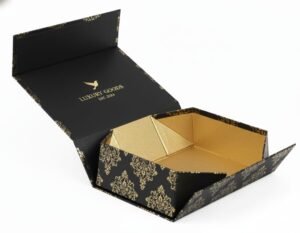
Rigid boxes are thicker and sturdier, often wrapped in specialty paper or fabric. The moment someone holds one, the difference is obvious.
These boxes are often used for:
- Luxury fragrances
- Gift sets
- Limited editions
Rigid perfume boxes create a sense of permanence. They feel intentional, almost ceremonial.
Kraft and recycled packaging
More and more brands are switching to kraft or recycled paperboard these days. It’s not just about the look—using these materials sends a clear message: we care about the planet. Vogue Business points out that refillable and recyclable perfume packaging is taking off, too, because people are paying closer attention to waste.
Common Perfume Box Sizes and Why Testing Matters
While custom sizing is ideal, many brands follow standard size ranges to ensure efficiency and protection.
| Bottle Size | Typical Box Dimensions (L x W x H) |
|---|---|
| 5–10 ml | 60–70 × 30–40 × 20–25 mm |
| 30 ml | 75–90 × 40–50 × 60–70 mm |
| 50 ml | 90–100 × 55–60 × 100–120 mm |
| 100 ml | 105–120 × 60–70 × 140–160 mm |
Even small differences in bottle shape can affect fit. This is why physical prototypes matter more than measurements on paper.
Design Trends Shaping Modern Perfume Boxes
Quiet luxury and minimalism
Modern perfume boxes are becoming calmer. Less text. Fewer graphics. More attention to spacing, texture, and typography. Luxury today whispers instead of shouting.
Sustainability-led decisions
Brands are reducing unnecessary layers, removing plastic inserts, and offering refill systems. Sustainability is no longer a bonus feature—it’s an expectation.
Interactive elements
Some perfume boxes now include QR codes that lead customers to scent stories, ingredient sourcing, or authenticity verification. This creates a bridge between physical packaging and digital experience.
How Perfume Boxes Shape Brand Identity Over Time
A brand’s perfume box often becomes its most recognizable feature. Bottles may change, formulations may evolve, but packaging builds consistency.
Customers remember:
- The way the box opens
- The texture of the paper
- The weight in their hands
The colors and typography
Over time, these details build trust. Recognition turns into loyalty.
Cost Considerations Without Overdesigning
Packaging costs depend on material choice, printing methods, finishes, and order volume.
Folding cartons are cost-effective and versatile. Rigid boxes cost more but often justify the investment through stronger shelf presence and gift appeal.
The smartest brands don’t overdesign every product. They choose where packaging should speak loudly—and where it should simply do its job.
Quick Comparison Table
| Box Type | Cost Level | Best Use |
|---|---|---|
| Folding carton | Low–Medium | Retail and travel perfumes |
| Rigid box | High | Luxury and gifting |
| Kraft box | Medium | Eco-focused brands |
| Drawer-style box | High | Limited editions |
Final Reflection
Perfume boxes don’t compete with the fragrance inside them. They prepare the way.
They protect something fragile. They set expectations. They create a moment of pause before experience begins.
When done well, a perfume box is not discarded. It lingers—on a shelf, in a drawer, in someone’s memory.
And that is where every fragrance truly begins.
Frequently Asked Questions
Are perfume boxes recyclable?
Many paper-based perfume boxes are recyclable. Mixed materials like plastic windows or heavy foils may reduce recyclability.
Do small brands need expensive perfume boxes?
Not necessarily. What matters most is clarity and intention, not price.
Why do people keep perfume boxes?
Because they hold memories. A well-designed box becomes part of the scent’s emotional value.