When you’re planning to package a book (or a set of books, special edition, collectible, etc.), one of the first questions you’ll face is: should I go for a slipcase or a box (or both)? Terms like “slip boxes,” “slip box,” and “custom book slipcase boxes” often appear in packaging conversations, but many creators and customers don’t pause to think about what truly sets them apart.
In this article, we’ll dive into:
Let’s roll.
First, the basics.
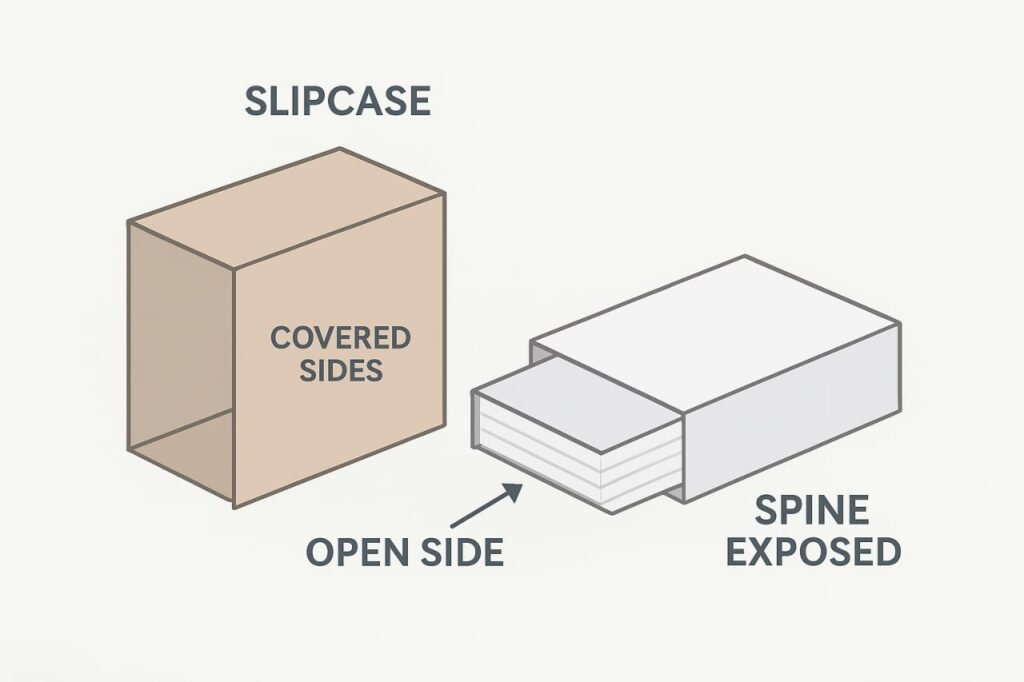
Visually:
The “open side” is where the book slides in; that side has no panel. The rest are enclosed.
Because of that structure, slipcases tend to emphasize easy insertion/removal along one axis rather than full enclosure.
When we say “box” (or “book box,” “custom box”), in the world of book packaging it often refers to more fully enclosed enclosures: for example:
In short: a “box” implies more full enclosure, perhaps more sides, hinged or lidded panels, full protection, often with interior trays or support structures.
Thus, a slipcase is a particular kind of box/enclosure—but a book box or other custom packaging box is a broader category.
Here’s a handy comparison:
| Feature / Consideration | Slipcase / Slip Box | Box (Book Box, Clamshell, Drawer, etc.) |
|---|---|---|
| Open sides | One open side for sliding in | Fully enclosed (lid, flap, or multiple panels) |
| Accessibility | Easy to slide in/out — good for shelves | May require removing lid, opening flap, or sliding drawer |
| Exposure | Spine or some part of cover remains exposed (visible) | Fully covered — more protection from dust, light, etc. |
| Protection | Good, but vulnerable on the open side | Stronger overall protection against elements |
| Structural complexity | Simpler design, fewer moving parts | More parts, hinges, flaps, etc. |
| Cost | Often lower (less material, fewer assembly parts) | Higher (more materials, more finishing, more complexity) |
| Aesthetic / premium feel | Elegant, slim, sleek — commonly used for deluxe editions | Very premium, luxury feel (especially with cloth, lining, foil) |
| Sustainability for special editions / archival | Excellent (if the exposed side is minimized) | Ideal for collectibles, archives, gift sets |
So in many ways, the tradeoff is: ease + visibility (slipcase) vs. maximum protection + exclusivity (box).
Here are key reasons to choose a slipcase (or slip box) for your project:
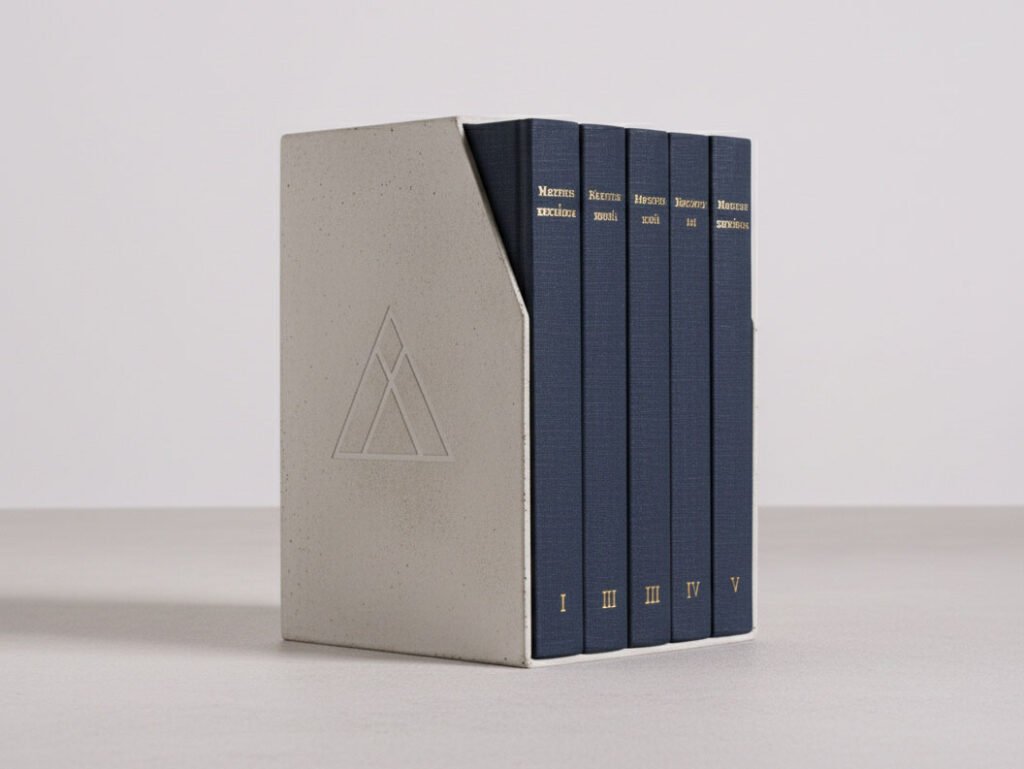
Because one side remains open, the spine of the book is visible on a shelf. This gives a clean, integrated look (your book spine still identifies the title) while adding an extra layer of protection.
Slipcases have a sleek, understated elegance. They don’t require flaps, lids, hinges, or clasps. This makes them a favorite in fine press, art books, and limited editions.
Since only one side is open and fewer panels are needed, material and assembly costs tend to be lower than more complex boxes.
Sliding in or out is intuitive and satisfying. No fiddling with lids, magnets, or clasps.
Slipcases are slimmer and take less material bulk when designed well, which is beneficial if shipping or shelf space is a concern.
Even with a slipcase, you can apply gorgeous finishes: foil stamping, embossing, spot UV, die cuts, textured papers, etc.
Use cases where slipcases shine:
There are scenarios where a more enclosed box is preferable:
If your project wants that ceremony of opening a lid, or you want interior liners, foam cutouts, etc., then a full box or clamshell style might be worth the extra cost.
To make your slip boxes or custom book slipcase boxes stand out (and last), here are several factors to keep in mind.
A slipcase must be a snug but not overly tight fit. Leave very small clearance (fractions of millimeters) so the book slides smoothly without wobble or scraping. If too tight, it scratches or deforms; too loose, it rattles.
Decide if your slipcase is top loading (book inserted from top) or side/sliding loading (inserted horizontally). Side loading is more common for books on shelves.
If your book is heavy, or includes extras like prints or foldouts, consider internal supports or reinforced edges.
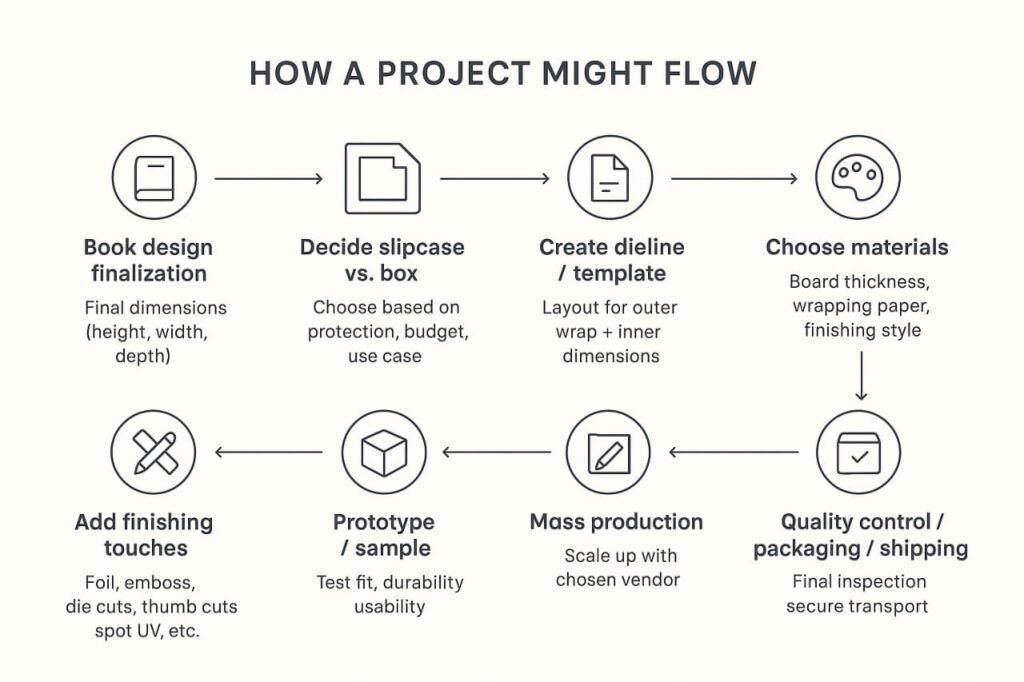
To illustrate, here’s a simplified design & production roadmap:
If possible, ask your box/slipcase vendor for a mockup or sample first to catch fit issues or finishing flaws.
Here are some FAQs you might want to anticipate in your blog:
Not exactly. While a sliding rigid box has a “drawer” inside and a sleeve outside, the mechanism and design differ. A slipcase is simpler and has only one open side.
A fully enclosed box (clamshell, tray + lid, etc.) tends to give better protection against dust, light, and moisture. If using slipcases, choose thicker board, good wrapping, and ensure the interior is clean and lined.
Yes, somewhat. But a well-designed slipcase adds minimal bulk relative to the protection it delivers. The tradeoff is often worthwhile for deluxe or collectible editions.
It depends on the manufacturer and complexity. Many slipcase orders begin in the hundreds. For instance, some packaging vendors require minimums for CD/DVD slipcase sets.
Use a smooth liner, avoid abrasive materials, consider reinforcing edges, and test your tolerances carefully so there is no friction.
Yes, but with caution. Heavy or bulky extras may push you toward a box with trays or compartments for better organization and protection.
Shelby is a Senior Packaging Consultant at YiHongBox, specializing in creative packaging strategies and sustainable solutions. With years of experience in design innovation and market trends, she helps brands craft impactful, eco-friendly packaging that resonates with customers and elevates brand identity. Shelby shares practical insights for business owners, designers, and marketers looking to turn packaging into a competitive advantage.

People often talk about product quality, branding, and pricing — but rarely do they pause to talk about the box itself. Yet in many cases,
Some packaging tries too hard. It throws bold colors, huge logos, and busy designs right in your face, begging you to notice. Then there’s a