I. Introduction: The Myth of "Cheap" Packaging vs. Value Engineering
In the competitive B2B retail landscape of 2026, “cost reduction” is every procurement manager’s primary KPI. However, when tasked with cutting the packaging budget, many fall into a dangerous trap: they assume that lowering costs means compromising on brand luxury, switching to flimsy materials, or downgrading the unboxing experience.
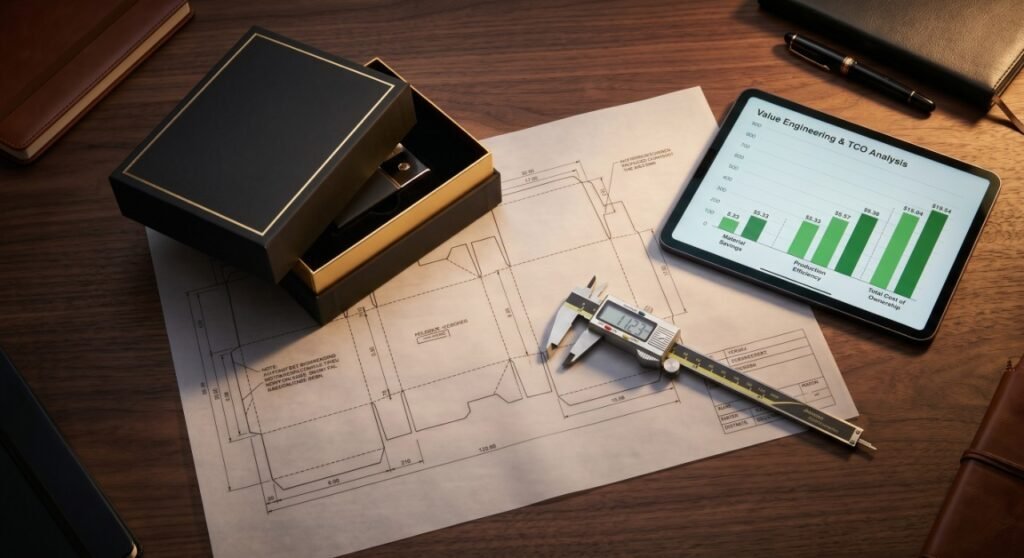
This is the myth of “cheap” packaging. True cost reduction is not about degrading your product’s presentation; it is about Value Analysis/Value Engineering (VAVE) and understanding the Total Cost of Ownership (TCO).
The true expense of your custom packaging often hides in the invisible inefficiencies of your supply chain—shipping empty air across the ocean, paying for excessive warehouse space, or losing time to complex assembly lines. By auditing your packaging structure, materials, and logistics, you can systematically strip away these hidden costs while maintaining, or even elevating, the premium feel your customers expect.
II. Structural Engineering: Designing for Logistics
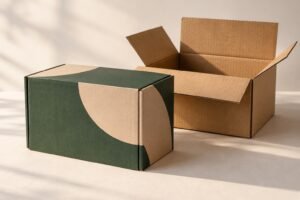
The physical volume of your packaging dictates your shipping and warehousing costs. With major carriers implementing increasingly strict dimensional weight (DIM weight) pricing models, international B2B trade heavily penalizes inefficient packaging. If your box is unnecessarily large, you are quite literally paying to ship empty air.. Smart structural engineering is the fastest way to slash these expenses.
![A macro close-up focusing on the meticulous process of Value Analysis (VAVE). A pair of professionally manicured hands (consistent with previous image styles) is evaluating a swatch of high-density greyboard and a piece of textured specialty paper. In the blurred background, a large monitor displays a complex 'Total Cost of Ownership (TCO) Bill of Materials' spreadsheet. The sharpest focus is on the tactile quality of the materials in the foreground, proving that 'cost optimization' does not mean 'cheap materials'. Crisp, analytical lighting.]](https://yihongbox.com/wp-content/uploads/2026/04/ChatGPT-Image-2026年4月28日-10_13_36-1024x558.png)
1. Flat-Shipping vs. Pre-Assembled Boxes
Whenever possible, pivot toward structures that can be shipped flat.
The Folding Carton Advantage: High-quality folding cartons or corrugated mailers ship completely flat. Compared to pre-assembled rigid boxes, flat-shipping can increase pallet density by up to 500%. This translates to an immediate saving of 60% to 70% on international ocean or air freight and drastically reduces the monthly storage fees at your fulfillment center.
2. The Power of "Nesting"
If your brand positioning absolutely requires luxury rigid gift boxes (which cannot be folded flat), shipping volume becomes a massive cost barrier.
The Strategy: We work with procurement teams to engineer a Nesting Strategy (think Russian nesting dolls). If you are ordering boxes in multiple sizes (e.g., a large apparel box and a smaller accessories box), we manufacture them so the smaller boxes fit perfectly inside the larger ones during shipping. This effectively ships two units for the dimensional freight cost of one.
3. Right-Sizing: Eliminating the "Air"
Many brands use standard, off-the-shelf box sizes that are slightly too big for their products, relying on excessive bubble wrap or void-fill paper to bridge the gap.
The Micro-Adjustment: By custom-engineering the box dimensions to hug your product precisely, you eliminate the need for expensive void-fill materials. More importantly, shaving just 10% off the overall volume of a box can mean fitting thousands of additional units into a standard 40ft shipping container, drastically driving down the landed cost per unit.
Logistics Cost-Reduction Strategies Comparison
| Strategy | The B2B Pain Point | The Engineering Solution | Cost Optimization Impact |
1. Flat-Shipping
| Pre-assembled boxes take up massive warehouse space and skyrocket shipping costs.
| Utilizing premium folding cartons or corrugated mailers that ship completely flat.
| Increases pallet density by up to 500%; saves 60-70% on international freight.
|
2. Nesting Strategy
| Luxury rigid gift boxes cannot be folded flat, making dimensional weight highly expensive.
| Engineering varied box sizes so smaller boxes fit perfectly inside larger ones during transit.
| Effectively ships two units for the dimensional freight cost of one.
|
3. Right-Sizing
| Standard off-the-shelf boxes are often too big, requiring expensive bubble wrap or void-fill.
| Custom-engineering the dieline to hug the product precisely, eliminating dead space.
| A 10% volume reduction allows thousands of additional units per 40ft container.
|
III. Total Cost of Ownership (TCO): Labor & Fulfillment Efficiency
![A dynamic side-by-side comparison shot on a modern warehouse packing station. On the left, a blurry, unmanicured hand struggles to fold a standard complex box, with a digital timer overlay reading '00:45 seconds'. On the right, a sharp, manicured hand (consistent style with previous images) effortlessly presses an engineered auto-bottom box, which snaps into a perfectly formed rigid shape, with a timer reading '00:03 seconds'. Focused lighting highlights time efficiency.]](https://yihongbox.com/wp-content/uploads/2026/04/Gemini_Generated_Image_nxl71unxl71unxl7_PhotoGrid-1024x557.png)
In B2B procurement, fixating solely on the “Unit Price” of an empty box is a critical mistake. To truly optimize your budget, you must calculate the Total Cost of Ownership (TCO), which includes the warehouse labor, assembly time, and fulfillment speed required to pack the box before it reaches the end consumer.
The Assembly Time Trap
A standard folding carton with manual tuck-flaps might cost $0.05 less to manufacture per unit than an engineered Auto-Bottom Box (Crash-Lock Carton). However, consider the reality on the warehouse floor:
Standard Box : Takes a worker 30 to 45 seconds to fold, align, and tape the bottom securely.
Auto-Bottom Box : Snaps into a perfectly rigid, locked shape in under 3 seconds with a single push.
According to logistics analyses by supply chain expertsn experts, labor is consistently the highest variable cost in warehousing. By investing slightly more in a fast-assembling structural design, you exponentially increase your hourly packing output. This VAVE strategy drastically reduces your overall operational and fulfillment costs, proving that a “more expensive” box can actually save you thousands of dollars a month.
IV. Material Substitution: Smart Swaps for Premium Impact
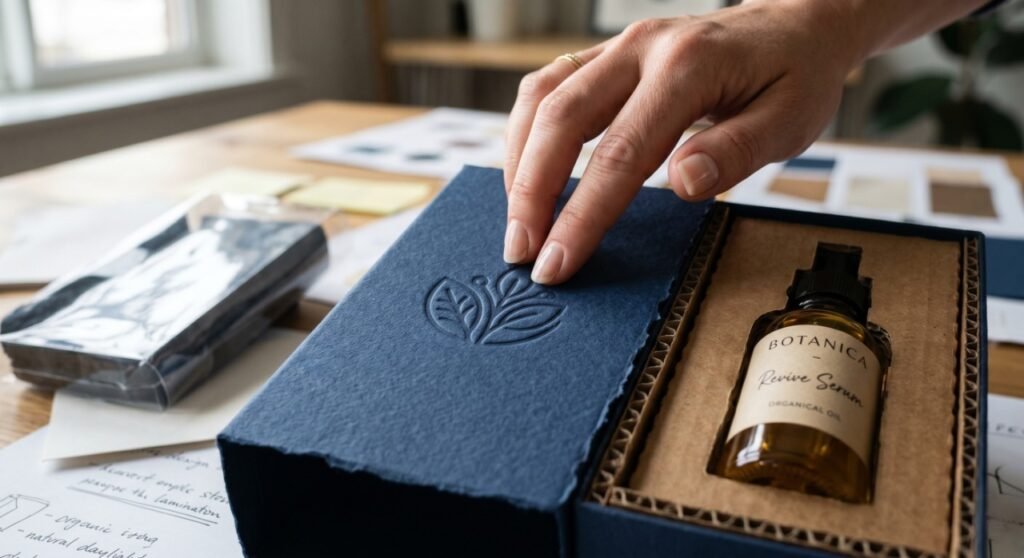
Cost optimization does not mean resorting to cheap, flimsy materials that damage your brand’s reputation. Instead, our packaging engineers focus on Material Substitution—making strategic swaps on the Bill of Materials (BOM) that lower manufacturing costs while preserving, or even enhancing, the premium unboxing experience.
Here are three high-impact material swaps we regularly implement for enterprise clients::
1. Board Density vs. Thickness : Many brands mistakenly believe a thicker box equals a more luxurious box. We routinely audit packaging and replace bulky, low-density 1200GSM board with high-density 1000GSM board. The high-density board is stiffer, more durable, and feels structurally superior, yet it uses less raw material and significantly reduces the final shipping weight.
2. Textured Specialty Paper vs. Heavy Lamination : Instead of printing a solid, full-bleed Pantone color on standard art paper and then paying extra for an expensive matte or soft-touch lamination, we recommend swapping to uncoated, naturally dyed specialty textured papers. This entirely eliminates the lamination process cost while delivering an organic, high-end “quiet luxury” aesthetic.
3. Insert Optimization : While custom EVA foam inserts are excellent for holding ultra-luxury heavy items (like glass perfume bottles), they carry a high material cost. For high-volume projects or lighter items, switching to custom die-cut corrugated board or eco-friendly molded pulp can slash internal packaging costs by up to 50% while still offering robust, shock-absorbent product protection.
V. SKU Standardization: Beating Tooling & Mold Costs
![The composition is structured like an engineering matrix, with subtle arrows pointing from closed master boxes to the open variety below. Subtle overlaid corporate graphics read: 'Standardized Outer Box: No New Tooling fees / Customized Inner Insert: SKU Optimized.' Authoritative, analytical lighting.]](https://yihongbox.com/wp-content/uploads/2026/04/Gemini_Generated_Image_k4rph9k4rph9k4rp_PhotoGrid-1024x557.png)
As highlighted by supply chain experts in the Harvard Business Review regarding the dangers of SKU proliferation, packaging costs for brands managing multiple product lines can quickly spiral out of control due to duplicate tooling and setup fees. Every unique box dimension requires a newly manufactured cutting die, separate printing plates, and individual machine setup times.
The most effective Value Engineering strategy to combat this is SKU Standardization, commonly known as the “One Box, Multiple Inserts” approach.
The Strategy : Instead of designing five completely different external boxes for a skincare line (e.g., one for eye cream, one for serum, one for moisturizer), you standardize the external dimensions of a single universal custom rigid box.
The Execution : The external box remains identical across the entire product line. You only customize the inexpensive internal inserts (like die-cut cardboard, molded pulp, or EVA foam) to securely nest the specific shape of each different product.
The Financial Impact : This completely eliminates duplicate tooling fees for the outer box. More importantly, it consolidates your purchasing power. Instead of placing five separate orders of 1,000 boxes (and paying a premium for short runs), you place a single order for 5,000 “master boxes,” instantly unlocking the deepest bulk manufacturing discounts.
VI. Printing and Finishes: The "Less is More" Approach
![The rest of the box uses significant negative space (white space) without CMYK printing. Warm, sophisticated lighting highlights the contrast between textured matte paper, metallic foil, and glossy UV, demonstrating that strategic, minimal finishes create high visual impact. Authoritative and premium.]](https://yihongbox.com/wp-content/uploads/2026/04/Gemini_Generated_Image_d76605d76605d766-1024x558.jpeg)
A common misconception in packaging design is that more complexity equals more luxury. In reality, complex printing and multiple layers of surface finishes increase manufacturing costs exponentially. Every additional color pass or foil application requires extra plates, more setup time, and higher scrap rates.
To optimize costs without losing the premium feel, we advise our B2B clients to embrace the “Less is More” aesthetic.
1. The Power of Minimalism
Modern luxury relies heavily on negative space (white space). Switching from full-coverage CMYK to a single-color print utilizing the official Pantone Matching System (PMS) ensures perfect brand color consistency globally, while significantly reducing plate and ink costs. Letting the natural texture of the paper act as the primary design element is both cost-effective and visually striking.
2. Strategic Embellishments
You do not need to cover the entire box in gold foil to make it look expensive. Spread-out, large-area foil stamping is notoriously costly and difficult to execute flawlessly.Instead, apply strategic embellishments. Focus your budget exactly where the customer’s eye naturally falls. Apply a high-gloss Spot UV coating or a small touch of Metallic Hot Foil exclusively to the central brand logo. This creates a high-contrast, premium focal point, delivering a massive visual impact while using only a fraction of the expensive finishing materials.
VII. The Hidden Cost of Returns: Why "Cheap" Costs More
According to industry return data analyzed by Shopify, damaged products are one of the leading causes of profit erosion. When procurement teams focus exclusively on lowering the “Unit Price,” they often overlook this catastrophic hidden expense.
Choosing a lower-grade corrugated board or skipping a custom shock-absorbent insert might save you $0.30 per box upfront. However, if that decision leads to a shattered glass serum bottle or a scratched luxury watch during transit, the financial fallout is severe.
The True Math of a Damaged Product
The true cost of a damaged product is not just the lost packaging. It includes:
Replacement Cost : Manufacturing and sending a completely new product.
Reverse Logistics : Paying exorbitant shipping fees to process the return.
Lost Customer Lifetime Value : A frustrated customer receiving a broken product is unlikely to order again, costing you hundreds or thousands of dollars in future revenue.
In the philosophy of Value Engineering, proper protection is a non-negotiable form of cost optimization. We mandate rigorous drop tests, vibration tests, and compression tests for all e-commerce custom packaging to ensure your upfront “savings” do not evaporate into backend refund claims.
VIII. Operational Efficiency: Ocean Freight & MOQ Strategies
The final frontier of packaging cost optimization lies entirely outside the physical box—it lives in your procurement timeline and order volume. Macro-level supply chain planning dictates the ultimate landed cost of your packaging.
1. MOQ and Tiered Pricing Leveraging
Small, frequent orders are the enemy of high profit margins. Custom manufacturing involves significant fixed setup costs, including die-making, machine calibration, and printing plate preparation. If you order 500 boxes, those setup costs are divided among 500 units, resulting in a high unit price.
The Strategy: Shift from reactive purchasing to proactive forecasting. By accurately predicting your demand for the next 6 to 12 months and consolidating your orders, you trigger significant Minimum Order Quantity (MOQ) tiered discounts. Scaling an order from 1,000 to 10,000 units can often reduce the raw manufacturing unit price by 30% to 50%.
2. The Timeline Premium: Sea Freight vs. Air Freight
Time is literally money in international B2B logistics.
The Trap: Ordering late forces procurement managers to rely on expedited air freight to hit retail launch dates. Because packaging is bulky, air freight is calculated by dimensional weight, often costing 5 to 10 times more than ocean freight. This single mistake can wipe out an entire quarter’s profit margin.
The Solution: Establish an unwavering operational discipline. Finalize your structural designs and place your bulk manufacturing orders 3 to 4 months in advance of your target launch date. This secures standard sea freight timelines, effectively transforming logistics from a massive expense into a predictable, optimized cost center.
IX. Sustainability: Eco-Friendly Equals Cost-Friendly
A lingering myth in B2B procurement is that sustainable packaging is inherently more expensive. While certain novel biomaterials do carry a premium, the fundamental principles of eco-friendly design perfectly align with cost optimization strategies.
In fact, with new international regulations—such as the EU Packaging and Packaging Waste Directive—designing for sustainability is now a crucial strategy for avoiding heavy corporate taxes.
Source Reduction : The most eco-friendly packaging uses the least amount of material. By right-sizing your box and utilizing high-density (but thinner) custom corrugated boards, you reduce your carbon footprint and your material costs simultaneously.
Eliminating Plastics : Removing unrecyclable plastic laminations and replacing them with water-based coatings or naturally textured papers lowers your manufacturing steps. Furthermore, it exempts your brand from the Extended Producer Responsibility (EPR) plastic taxes levied in many European and North American markets.
X.Conclusion & Call to Action
In the modern supply chain, true packaging cost optimization requires a holistic view. It is not about squeezing your manufacturer for a few pennies on raw materials at the expense of quality. It is about implementing Value Engineering—right-sizing your dimensions to slash freight costs, standardizing your SKUs to eliminate tooling waste, and designing fast-assembling structures that cut warehouse labor in half.
Are you paying for “hidden inefficiencies” in your current packaging? Let our engineering team uncover them.
Get a Free VAVE Packaging Audit Today. Send us your current packaging dimensions and material specs. The structural engineers at Yihong Packaging will analyze your Total Cost of Ownership (TCO) and provide a comprehensive report on how to optimize your materials, reduce your shipping volume, and maximize your profit margins. Contact us now to start saving.
FAQ
Are cutting die (tooling) costs a one-time fee?
Yes! Once you pay the initial setup fee for a custom cutting die or mold, we keep it on file. For all your future reorders of that exact same structural design, you will not be charged the tooling fee again, immediately lowering your unit cost on the second run.
How much does increasing our order quantity really impact the unit price?
Significantly. Printing presses and automated folding machines require 1-2 hours just to be calibrated for your specific box. If you order 1,000 units, the cost of that 2-hour labor is divided by 1,000. If you order 10,000 units, it is divided by 10,000. Increasing volume can often cut the raw manufacturing cost by 30% to 50%.
We want the 10,000-unit bulk discount, but we don't have the warehouse space to store them all at once. What are our options?
This is a common challenge for growing brands. We offer Split-Shipment (Call-off) strategies. We can manufacture the full volume of 10,000 units to lock in your lowest discounted unit price, ship the first batch to you immediately, and hold the remaining inventory in our facilities, shipping them to you on demand over a designated period.
We have a tight budget. What is the most cost-effective box style that still looks premium?
A well-engineered Auto-Bottom Folding Carton made from thick, uncoated specialty paper with a single-color hot foil stamp. It ships flat to save massive freight costs, assembles in 3 seconds to save labor, and the minimalist foil gives it a high-end boutique feel.
Is Pantone (PMS) printing more expensive than standard full-color (CMYK) printing?
It depends on your design. If your design only uses 1 or 2 solid brand colors, using specific Pantone inks is actually cheaper and provides much better brand consistency than running a 4-color CMYK process. However, for complex photography, CMYK is required.
Do I need to pay for a physical sample, and is it actually worth the cost?
While we provide digital 3D proofs for free, a physical Pre-Production Sample (PPS) incurs a small setup fee. However, this is the ultimate cost-saving step. Testing a physical sample with your actual product prevents catastrophic mass-production errors (like incorrect sizing or insert fit). Furthermore, the sample fee is typically credited back to your balance when you place the bulk order.