Premium spirits packaging is not a decorative afterthought. For a D2C liquor brand, it is a shipping system, a compliance surface, a gift object, a damage-control tool, and a conversion asset. When a glass bottle contains whiskey, gin, tequila, rum, cognac, liqueur, or a limited-release blend, the package must solve a harder problem than ordinary ecommerce packaging: it must move fragile liquid value through a parcel network without making the customer feel that the brand gave up on luxury at the last mile.
This is where the industry often defaults to the ugly inflatable air column. It reduces breakage, but it also creates an unboxing contradiction. The customer buys liquid gold and receives a swollen plastic cage. From a packaging engineer’s point of view, the question is not “How do we make air columns prettier?” The better question is: How do we design a bottle-first protection system that makes air columns unnecessary?
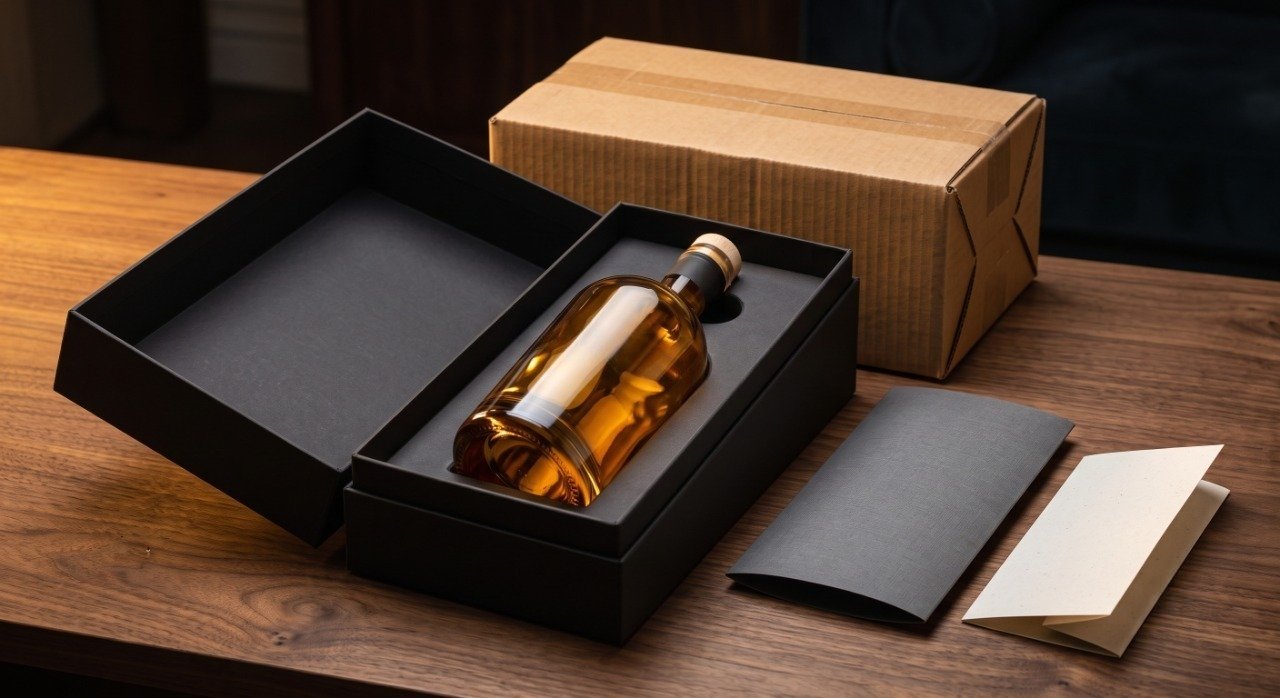
Data Signals a Packaging Team Should Not Ignore
A professional packaging recommendation should be supported by market, sustainability, logistics, and ecommerce data.meta facebook The point is not to decorate the article with famous names. The point is to connect each data point to a concrete packaging decision.
| Data Source | Relevant Data or Finding | Packaging Implication for D2C Spirits |
|---|---|---|
| U.S. EPA | 2018 U.S. containers and packaging: 82.2 million tons, or 28.1 percent of municipal solid waste. Corrugated boxes: 96.5 percent recycling rate. | Right-size cartons. Reduce unnecessary plastic. Use fiber-based structures when they still pass protection tests. |
| AF&PA | More than two-thirds of recycled paper in the U.S. becomes new products. In 2024, nearly half went into containerboard for cardboard boxes. | Corrugated and paperboard are not just “eco-looking.” They can fit a mature recovery stream when specified correctly. |
| McKinsey | 60 to 70 percent of U.S. consumers said they would pay more for sustainable packaging. 57 to 60 percent ranked glass, paperboard, and paper as extremely or very sustainable. | Sustainable bottle packaging does not have to look plain. Premium paper systems can still signal luxury. |
| Baymard Institute | Average documented cart abandonment: 70.22 percent. Excluding “just browsing,” 39 percent cite extra costs and 21 percent cite slow delivery. | Show packaging and delivery confidence before checkout. A high-value glass bottle needs risk reduction early. |
| Vogue Business / Mondi survey reporting | Vogue Business reported Mondi survey data: 78 percent of respondents would be inclined to repeat purchase after a distinctive unboxing experience. | Unboxing is not vanity. It can support repeat purchase, gifting confidence, and brand memory. |
| FedEx, USPS, and TTB | Alcohol shipping is not a normal consumer parcel category. It must follow licensed and regulated pathways. | Define the shipping model first. Then specify the box, insert, labels, and outer carton. |
The Packaging Engineer’s Diagnosis: Air Columns Are a Symptom
Air columns usually appear when packaging development starts too late. The bottle is already selected, the label is approved, the launch calendar is fixed, and fulfillment suddenly asks how to prevent breakage. Inflatable protection becomes the fastest patch because it does not require a precise insert, a new rigid box, or a tested outer carton.
That speed has a cost. Air columns do not create a controlled load path. They do not present the brand. They can hide the bottle, trap the customer in a noisy opening experience, and make the packaging feel like temporary waste. For entry-level shipments, this may be acceptable. For premium D2C spirits, it weakens the perceived value of the product.
A professional replacement starts with the bottle, not the box. Before choosing board grade, coating, insert style, or printing finish, the packaging team should record the bottle’s physical risk profile.
| Engineering Input | Why It Matters | Packaging Decision It Controls | Common Mistake |
|---|---|---|---|
| Filled bottle weight | Determines drop energy and compression risk | Outer shipper grade, insert thickness, base support | Designing from empty bottle weight only |
| Neck diameter and closure height | Controls leakage, cap impact, and vertical lock | Top collar, clearance zone, cap-protection pocket | Letting the cap touch the lid or shipper wall |
| Shoulder geometry | Absorbs side shock and can chip under impact | Side ribs, molded cradle, die-cut bridge | Supporting only the cylindrical body |
| Label and decoration | Labels, wax seals, foils, and embossing scuff easily | Surface clearance, paper liner, opening orientation | Protecting the glass but damaging the label |
| Order configuration | Single bottle, two-bottle, and kit formats fail differently | Multi-cavity tray, divider, sleeve, gift-box platform | Using one generic void-fill method for all SKUs |
Design the Load Path Before the Visual Identity
In protective packaging, the load path is the route that force takes when a parcel is dropped, compressed, or vibrated. Air columns try to surround the product with a soft envelope. A better premium system moves force around the bottle: from the outer carton into engineered corners, ribs, collars, trays, and board folds, while keeping the glass away from direct impact zones.
This is why premium bottle packaging should be specified as a system. A custom packaging box can provide the outer strength; a rigid box or magnetic rigid box can create the presentation layer; and an internal cradle or insert can lock the bottle without relying on loose plastic cushioning.

A Five-Layer System for D2C Spirits
For premium D2C spirits, the most reliable replacement for air columns is not one material. It is a five-layer architecture. Each layer has a job, and none should be asked to do everything.
| Layer | Technical Job | Brand Job | YihongBox Application |
|---|---|---|---|
| Distribution shipper | Resist drops, compression, stacking, and handling abrasion | Arrive clean, right-sized, and professional | Custom packaging box with optimized corrugated grade |
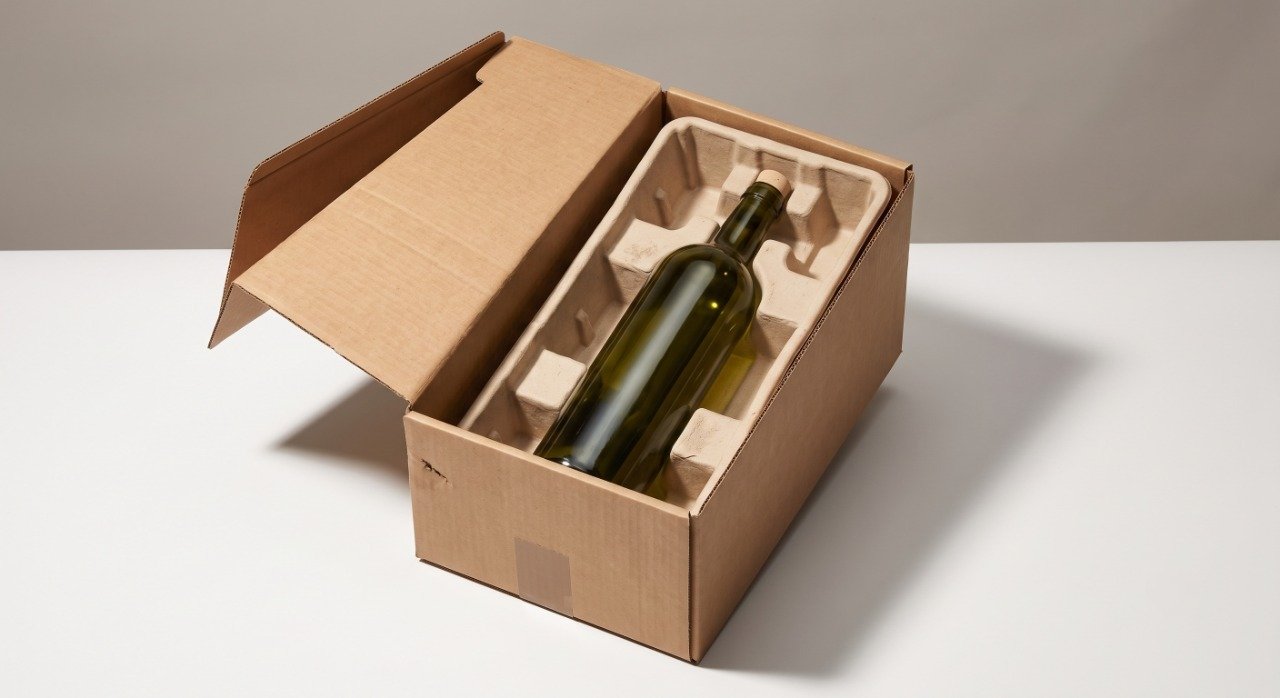
| Impact-management insert | Create clearance around neck, shoulder, body, and base | Make protection look intentional, not improvised | Paperboard cradle, corrugated suspension, molded pulp, or custom foam inserts where appropriate |
| Presentation box | Hold the bottle in the reveal position | Deliver gift value and premium perception | Custom gift boxes, black gift boxes, or magnetic closure structures |
| Campaign skin | Protect print, contain information, and adapt to seasonal drops | Create limited-edition distinction without rebuilding the core box | Custom packaging sleeves with batch-specific graphics |
| Information layer | Carry handling notes, batch story, QR code, care instructions, and compliance cues | Convert the shipment into a guided tasting or gifting moment | Insert card, printed lid copy, bottle-facing panel, or product guide |
Material Selection: Start With Failure Mode, Not Fashion
Packaging buyers often ask whether molded pulp, corrugated board, greyboard, paperboard, or foam is “best.” In professional packaging development, the answer depends on the expected failure mode. A tall bottle with a fragile neck needs different protection from a short heavy decanter with a thick base. A wax-sealed collector’s bottle needs different clearance from a standard screw-cap gin bottle.
Use the material table below as a practical specification guide.
| Structure | Best Use Case | Strength | Watch-Out | Premium Finish Strategy |
|---|---|---|---|---|
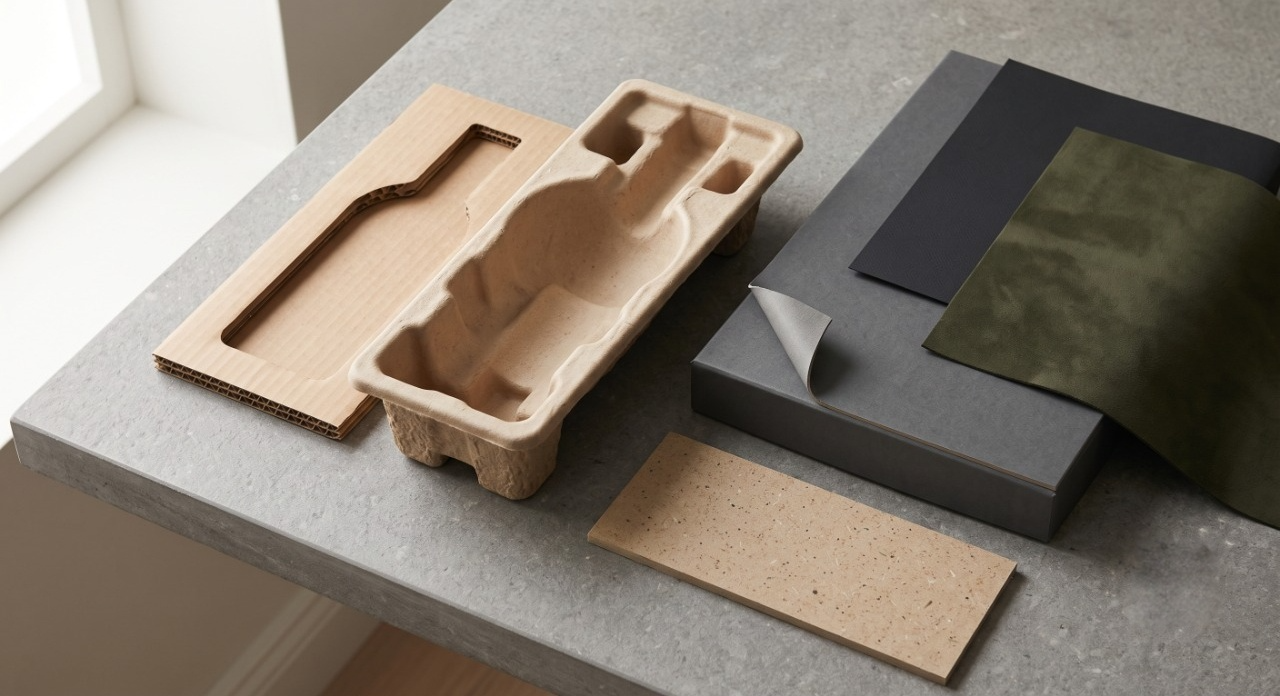
| Molded pulp cradle | Stable bottle shape, sustainability-led brand, higher repeat volume | Excellent form fit, plastic reduction, tactile fiber story | Tooling, dimensional tolerance, moisture sensitivity if underspecified | Natural fiber texture, debossed logo, printed sleeve outside the cradle |
| Die-cut corrugated insert | Fast iteration, ecommerce shipping, multi-bottle programs | Strong compression logic, flat shipping, easy prototyping | Needs precise folding and assembly control | Printed interior, color-matched liner, clean tab-lock geometry |
| Rigid greyboard tray | Collector gifts, PR sets, premium holiday releases | High perceived value and strong presentation platform | Should not replace the protective shipper by itself | Soft-touch paper, blind debossing, foil detail, velvet paper liner |
| Foam or hybrid insert | Very heavy bottles, complex shapes, short-run sample kits | Strong cushioning and precise cavities | Material claims must be handled carefully; recyclability may vary | Use sparingly, cover with printed board, reserve for high-risk formats |
| Window presentation box | Retail-ready D2C, bottle color reveal, gift preview | Lets the customer see the label or liquid before opening | Window cutouts can weaken panels if poorly placed | Window gift boxes with controlled reveal and reinforced edges |

The Air Column Exit Plan: A Practical Development Sequence
Replacing air columns should not be treated as a graphic redesign. It should be managed as a packaging development project with measurable gates. A simple sequence works well for D2C spirits brands:
- Measure the bottle family. Record height, width, neck diameter, closure height, filled weight, label position, decoration, and center of gravity.
- Map the shipping promise. Define domestic parcel, international parcel, subscription shipment, PR sample, retail gift, or licensee-to-licensee trade sample.
- Choose the protection principle. Decide whether the bottle will be blocked, braced, suspended, cradled, or presented in a rigid platform.
- Prototype in white sample first. Test the structure before investing in full print and finishing.
- Run distribution testing. Evaluate drops, compression, vibration, closure performance, label scuffing, and carton integrity.
- Refine the opening sequence. Make sure the package opens cleanly, presents the bottle correctly, and does not require excessive tools, tearing, or force.
- Lock the production specification. Define board grade, flute, paper wrap, coating, insert tolerance, print method, assembly SOP, and packing instructions.
This sequence aligns with the way professional packaging teams work: first protect the product, then refine the presentation, then scale the system.
Testing Criteria: What “Shipping-Safe” Should Mean
Claims such as “shockproof” or “shipping-safe” are weak unless they are tied to a test plan. ISTA provides package testing resources for transit performance, and ASTM D4169 is a recognized practice for performance testing of shipping containers and systems. Brands do not need to turn every blog reader into a test engineer, but they should communicate that serious bottle packaging is validated, not guessed.
| Test Area | What to Check | Pass Condition | Packaging Adjustment If It Fails |
|---|---|---|---|
| Drop orientation | Corner, edge, side, top, and base drops | No glass breakage, no closure leak, no unacceptable gift-box deformation | Increase corner protection, add base pad, change insert geometry |
| Compression | Stacking pressure during warehousing and delivery | Outer carton maintains structure; inner gift box remains presentable | Upgrade corrugated grade, change flute, adjust box dimensions |
| Vibration | Long-route truck, conveyor, and parcel movement | Bottle does not walk, rotate, rub, or loosen inside the pack | Tighten neck collar, add shoulder ribs, improve base pocket |
| Scuff and abrasion | Label, foil, wax seal, sleeve, and printed panels | Decorative surfaces remain retail-ready after transit | Add paper liner, change coating, increase clearance, alter orientation |
| Opening behavior | Customer unboxing with normal hand force | Clear reveal, no messy filler, no awkward bottle extraction | Change pull tab, tray angle, finger notch, or lid friction |
Compliance: Packaging Cannot Ignore Alcohol Shipping Rules
Alcohol logistics is regulated, and packaging choices should not be separated from fulfillment rules. FedEx’s alcohol shipping guidance states that consumers cannot ship alcohol through FedEx and that approved licensed shippers must follow carrier and legal requirements. USPS Publication 52 lists mailability restrictions for intoxicating liquors. The Alcohol and Tobacco Tax and Trade Bureau is also a core federal reference point for U.S. beverage alcohol industry compliance.
This article is not legal advice. For a packaging project, the practical point is simple: the box should be designed around the actual shipping model. A legal licensee-to-consumer wine program, a licensee-to-licensee spirits sample, a retail gift set, and a non-alcohol display mockup can have different labeling, routing, signature, and documentation needs. Build the packaging specification only after the shipping pathway is clear.
Luxury Presentation Without Fragility
Many spirits brands want the tactile drama of a luxury box but still need ecommerce durability. The mistake is trying to make one beautiful box do both jobs. A better approach is a dual-structure system: a strong distribution shipper outside and a refined presentation box inside.
For example, a limited-run whiskey can use a matte black rigid box as the collector-facing layer, paired with a die-cut corrugated suspension tray and an unprinted test shipper during validation. A seasonal gin kit can use a printed paperboard sleeve over a stable core box, allowing the brand to change artwork without rebuilding the insert. A premium tequila PR set can use a rigid tray with a neck bridge, recipe card, and accessory cavity, then ship inside a protective mailer.
Sustainability: Replace Plastic Theater With Verified Material Logic
Moving away from plastic air columns can support a more credible sustainability story, but only if the replacement is specified honestly. A fiber-based insert is not automatically better if it is overbuilt, coated in hard-to-recycle film, or shipped in an oversized carton. A sustainability claim should be connected to material reduction, recyclability, responsible sourcing, or reuse potential.
References such as How2Recycle, the FSC label guide, and the Sustainable Packaging Coalition are useful for brands thinking about communication, sourcing, and consumer disposal instructions. For premium spirits, the strongest sustainability story is usually not “plain kraft.” It is a leaner system: less void, fewer mixed materials, right-sized cartons, clearer disposal language, and a structure that still feels expensive.
Conversion: Show the Packaging System Before Checkout
Packaging can reduce purchase anxiety. A D2C customer buying a high-value bottle has four concerns: Will it break? Will it leak? Will it look giftable? Will the recipient understand that it is premium? The product page should answer those concerns visually.
That is why packaging images should show more than the bottle. Show the outer shipper, inner gift box, insert, sleeve, reveal angle, and label protection. If the brand sells corporate gifts or PR kits, show the pack as a complete gifting system. YihongBox can support this across custom gift boxes, packaging sleeves, custom inserts, and magnetic rigid boxes.
Specification Checklist for Replacing Air Columns
Before asking a packaging supplier for a quotation, prepare a real specification brief. This reduces sampling rounds, prevents weak structures from being dressed up with premium finishes, and helps the supplier recommend the right construction.
| Brief Item | Information to Provide | Why It Improves the Result |
|---|---|---|
| Bottle data | Filled weight, dimensions, neck, closure, center of gravity, label position | Allows the insert and clearance zones to be engineered correctly |
| Shipping model | D2C parcel, trade sample, retail gift, subscription, international route | Controls shipper strength, labeling, and testing scope |
| Brand tier | Mass premium, luxury, collector, corporate gift, PR launch | Guides finish level, rigid-box structure, and unboxing sequence |
| Sustainability goal | Plastic reduction, recyclability, FSC sourcing, lower void ratio, reuse | Prevents vague claims and aligns materials with the brand story |
| Commercial target | MOQ, unit cost range, sample timeline, assembly labor, launch date | Keeps the design premium but manufacturable |
What a Better D2C Spirits Pack Feels Like
The customer should not see a protection problem. They should see a deliberate sequence: a right-sized parcel, a clean opening path, a structured reveal, a bottle that sits securely, and materials that match the price of the liquid. The package should make the buyer feel that the brand controlled every detail, from distillation to doorstep.
That is the real way to abandon ugly air columns. Do not remove them because they look bad. Remove them because the brand has replaced them with a better engineering logic.
Build the Next Spirits Packaging System With YihongBox
If your brand is still using air columns for premium liquor, wine, liqueur, or beverage gifts, the next step is not simply to order a nicer box. The next step is to define a complete packaging system: distribution shipper, bottle insert, presentation box, campaign sleeve, print finish, test plan, and assembly process.
Explore YihongBox custom packaging box manufacturing, rigid box solutions, magnetic rigid boxes, custom inserts, and custom packaging sleeves. To discuss a bottle packaging project, contact the YihongBox team with your bottle dimensions, target market, shipping route, and desired unboxing experience.
FAQ: Premium Spirits Packaging Without Air Columns
Can a premium spirits brand ship without inflatable air columns?
Yes, but the replacement must be engineered. A tested combination of outer shipper, bottle insert, rigid presentation box, and controlled clearance can replace air columns while improving unboxing quality.
What is the most important part of protective liquor bottle packaging?
The insert system is usually the most important component because it controls the neck, shoulder, body, and base. However, the insert must work with the outer carton and presentation box, not independently.
Is molded pulp always better than foam?
No. Molded pulp is strong for sustainability-led, repeat-volume programs with stable bottle geometry. Foam or hybrid inserts may be appropriate for very heavy, irregular, or short-run premium formats. The best choice depends on risk, brand claims, and order volume.
Should the rigid gift box be used as the shipping box?
Usually no. A rigid gift box is designed for presentation. It should be protected by a distribution shipper if the package will move through parcel networks.
How many samples should a spirits brand test?
At minimum, test white structural samples before printed samples. For high-value bottles or national D2C programs, test multiple filled-bottle samples across drop, compression, vibration, and opening behavior.
How can packaging content improve SEO?
Use precise terms such as premium spirits packaging, liquor bottle packaging, wine shipping boxes, custom rigid bottle boxes, protective bottle inserts, and air column alternatives. Add useful tables, image alt text, internal links, and external references to recognized packaging and compliance resources.