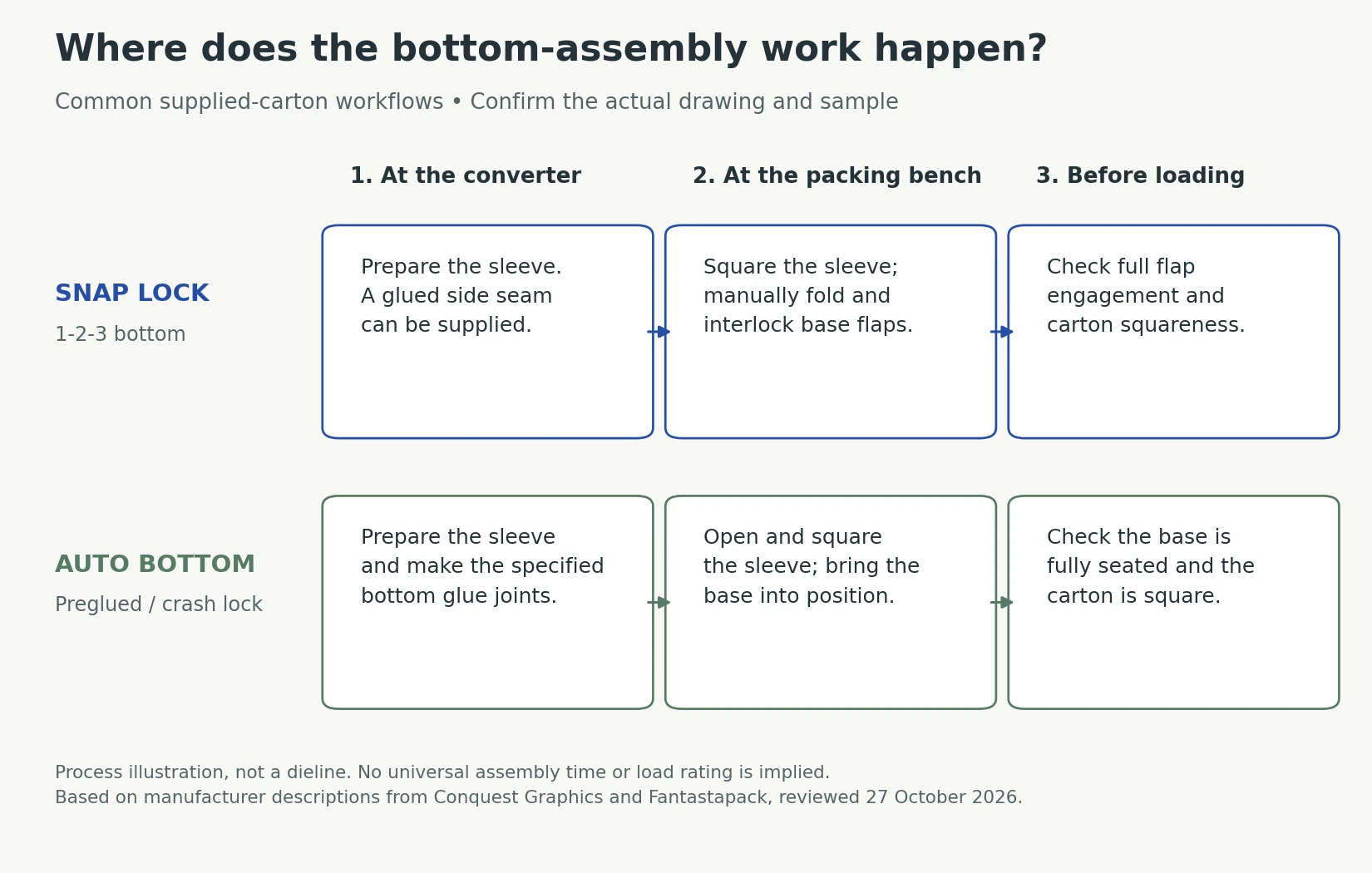
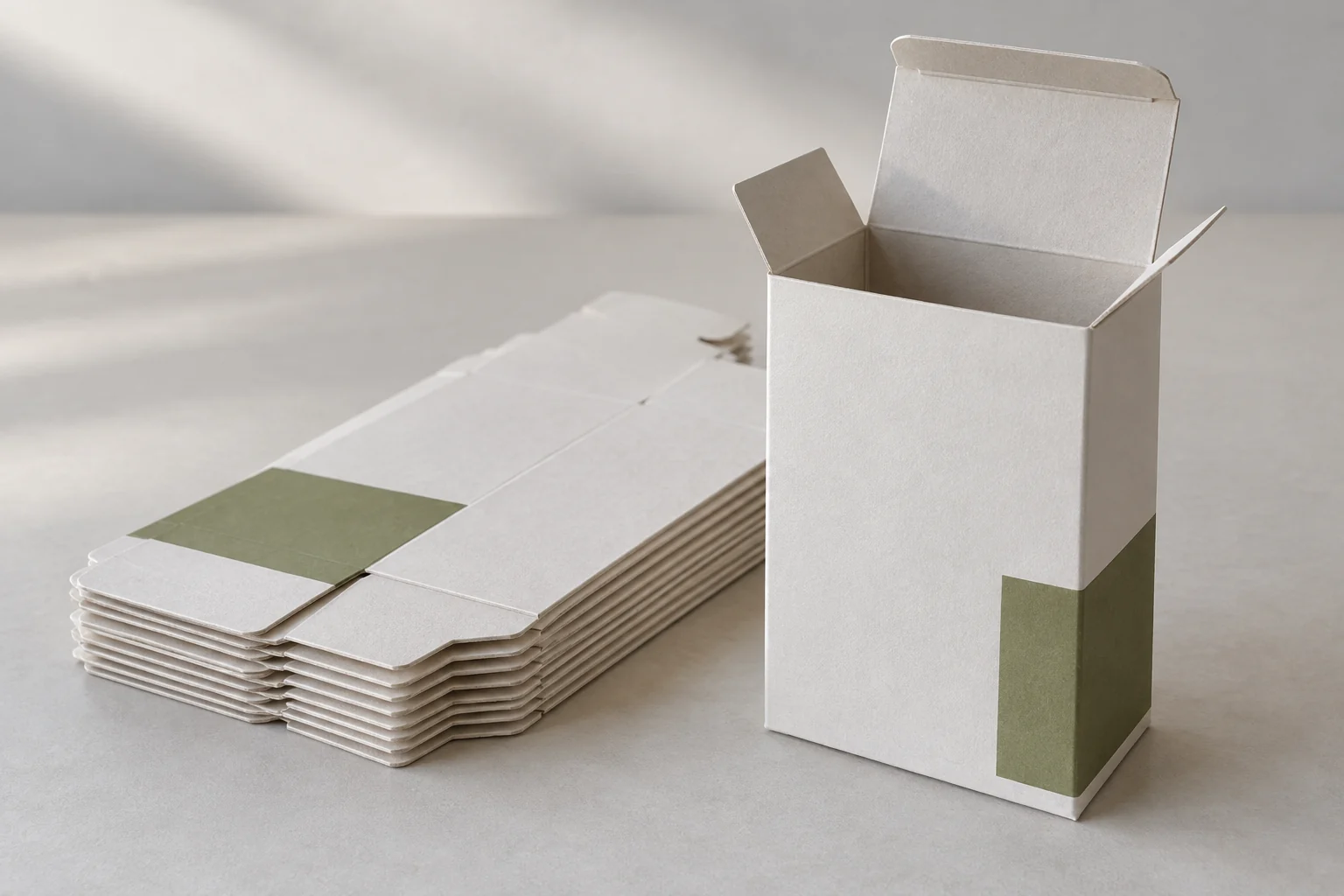
Auto-lock and snap-lock bottoms differ mainly in how the base is formed. An auto-bottom carton arrives with its bottom glue joints already made, so opening and squaring the sleeve brings the base into position. A snap-lock, or 1-2-3 bottom, requires the packer to fold and interlock its bottom flaps. Compare the delivered box price, real packing time and loaded sample performance before choosing either structure.
Reviewed: · YiHongBox · Manufacturer references and published wage context; the cost model is a transparent hypothetical example.
A lower carton price can be offset by extra setup work. Equally, paying for a preglued base may add little value if another task already controls packing speed. This guide is for buyers comparing custom folding cartons for retail products, gifts and small kits. It separates structural facts from the numbers you need to measure in your own operation.
In this guide: Names and assembly · Comparison · Cost worksheet · Sample checks · FAQ
What do auto-lock, crash-lock and 1-2-3 bottom mean?
Auto bottom and crash-lock bottom are names commonly used for a preglued base that forms as the carton sleeve opens. Snap-lock bottom and 1-2-3 bottom commonly describe a base whose four flaps are manually folded into an interlocking closure. Confirm the supplier’s actual drawing and sample, because a style name is less precise than an approved construction.
The Conquest Graphics comparison describes those assembly differences. A separate manufacturer, Fantastapack, describes its snap-lock product as four flaps folded and locked to form the base. Its featured product uses corrugated material; do not transfer that product’s dimensions or material properties to every paperboard carton.
Bottom gluing and side-seam gluing are separate operations. A snap-lock carton may arrive with its side seam already glued even though the packer closes its bottom without adding adhesive. For a supplied, preglued auto-bottom design, the relevant bottom gluing happens during conversion. Ask who performs each operation and what the packer actually receives. “Auto” also does not mean the box is automatically filled or closed by a machine.
Compare the work involved, not just the style name
| Buyer question | Snap-lock / 1-2-3 bottom | Preglued auto bottom |
|---|---|---|
| What does the packer do? | Square the sleeve and fold the base flaps in their specified interlocking sequence. | Open and square the sleeve, then check that the preglued base is fully seated. |
| Is bottom adhesive added at packing? | Normally not for the interlocking base as specified; confirm any extra sealing requirements. | Not for the supplied preglued joints; confirm the delivered construction. |
| Can it store flat? | Commonly supplied collapsed, subject to the design and packing arrangement. | Commonly supplied collapsed with the base preglued, subject to the design. |
| Which has the lower purchase price? | Request a matched specification; manual bottom assembly may avoid some converting cost. | Additional converting work can affect price. Obtain the actual quote. |
| Which can support the product? | Assess board, base geometry, engagement, insert and loaded sample together. | Assess those factors plus the actual glued joints and completed base. |
| What should be timed? | Opening, flap closure, correction and readiness for loading. | Opening, squaring, base check and correction—not only the initial opening motion. |
Top closure and bottom closure should be specified separately. A tuck-top appearance does not tell you which base sits underneath it. Likewise, a board’s GSM does not establish how either finished base performs; see our paperboard grammage and thickness guide for that distinction.
Will an auto bottom make your packing operation faster?
It can remove manual bottom-flap folding, but its value depends on the complete packing sequence. If one person opens a carton, places an insert, loads a bottle, adds instructions and closes the lid, measure the whole cycle as well as bottom setup. Saving one action will not necessarily shorten total output time by the same amount if insert preparation or product loading is the bottleneck.
Run both samples under comparable conditions: the same product, operator, work surface and supply arrangement. Define the start and finish of the task. Include misfolds and corrections, rather than timing only the fastest successful attempt. Record repeatable observations after the operator understands each design. Report the number of cartons timed and the method alongside the result; do not treat a single demonstration as a production standard.
Calculate box cost plus packing labor
Use one currency and the same cost scope for both proposals. Start with the delivered carton price, then add the labor associated with the operation you measured. Include setup, tooling, extra material or rework differences separately if they are relevant; a simple unit-price comparison can miss them.
Comparable cost per packed unitDelivered box cost + (measured seconds × loaded hourly labor cost ÷ 3,600) + other allocated differences
Labor value of the time saved(snap-lock seconds − auto-bottom seconds) × loaded hourly labor cost ÷ 3,600
For real published context, O*NET’s US national table for Packers and Packagers, Hand, citing BLS 2025 wage data, reports an hourly median of US$17.44. Its 25th and 75th percentiles are US$15.49 and US$20.70. These are occupation-wide wages, not carton-assembly rates, employer total labor costs or quotes for a packing service.
Use your finance team’s relevant labor rate for the calculation. Wages alone do not capture every employer cost. Buyers packing in Canada or Australia should use their local currency and actual operation’s figures; the US data is context, not a transferable rate card.
Worked example: a higher box price can break even
The following inputs are invented solely to explain the calculation. They are not YiHongBox prices, measured assembly times, customer results or an industry benchmark. Assume a matched 5,000-unit order with no difference in the other allocated costs:
| Illustrative input or result | Snap lock | Auto bottom |
|---|---|---|
| Delivered box cost per unit — assumed | US$0.42 | US$0.46 |
| Measured-task time per unit — assumed | 9 seconds | 3 seconds |
| Loaded hourly labor cost — assumed | US$24 | US$24 |
| Labor cost per unit — calculated | US$0.06 | US$0.02 |
| Combined cost per unit — calculated | US$0.48 | US$0.48 |
| Combined cost for 5,000 units — calculated | US$2,400 | US$2,400 |
Here, six assumed seconds saved are worth US$0.04 at the assumed US$24 hourly rate. That equals the assumed US$0.04 carton premium. The labor difference is 8⅓ hours over 5,000 units, worth US$200, while the extra carton spend is also US$200. There is no saving in this scenario; it is the break-even point under the stated assumptions.
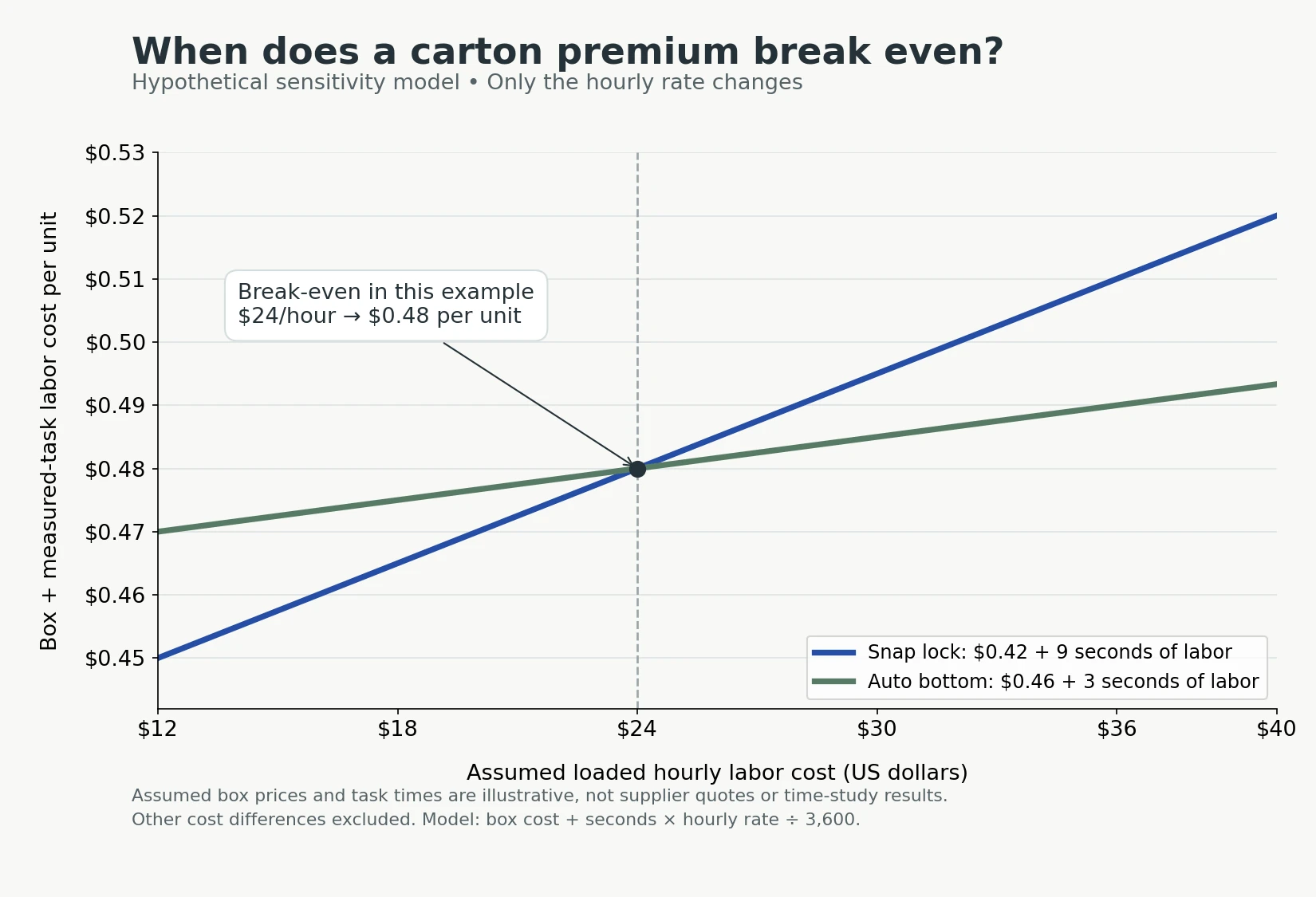
If actual time saved is smaller, an auto-bottom premium needs more justification. If the premium is smaller or repeatable time savings are larger, the calculation moves the other way. Add any one-time tooling difference before comparing a small order. Multiply a per-unit saving by the quantity to estimate its order value, but remember that saved minutes do not automatically reduce paid hours or invoices.
Which bottom can hold your product?
Neither style name supplies a universal weight rating. Check the approved board grade, footprint, flap geometry, glue specification where applicable, insert and load position. A compact candle jar and a wide gift assortment put different demands on a base even when their total weight is the same. Supplier descriptions of “heavy-duty” do not replace a defined acceptance requirement.
For candle cartons, assess the filled jar, not an empty vessel. For perfume packaging, check cap clearance and insert support together. For reed diffuser packs, keep the long reeds separated from the bottle and confirm that they do not become unintended supports. A fitted insert can change the load path, so approve it with the carton.

On each physical sample, check that the base engages fully, the carton stays square, the intended product can be loaded without forcing, and normal removal does not release the base. Inspect relevant glued joints and repeat the intended handling sequence. Agree on the distribution test and acceptance criteria for the complete filled pack. ISTA’s procedure overview distinguishes test families and is a useful starting point for a discussion with a qualified lab.
What should a matched quotation include?
Ask for both structures against the same internal dimensions, packed product, board proposal, printing, finish, quantity and delivery scope. Identify the exact supplied state: collapsed sleeve, bottom preglued where applicable, inserts included or separate, and any work left to your packing team. Request a physical sample of each shortlisted construction before final selection.
Keep the top closure, barcode location and visible artwork consistent where practical so they do not distract from the base comparison. Use the approved carton dieline to record the selected base and revision. If you switch the bottom later, reconfirm its cut, crease, glue and artwork implications rather than treating it as a cosmetic rename.
Frequently asked questions
Is an auto-lock bottom the same as a crash-lock bottom?
Those names commonly refer to a preglued base that forms when the carton sleeve is opened. Confirm the supplier’s drawing, supplied state and physical sample because terminology alone does not define every detail.
Why is a snap-lock base called a 1-2-3 bottom?
The name describes its manual folding sequence. The base commonly uses four flaps that are folded and interlocked in stages. Follow the specific design’s instructions rather than assuming every carton has identical flap shapes.
Does snap lock mean the entire carton contains no glue?
No. The base may close without adhesive added by the packer while the side seam is already glued. State bottom closure and side-seam preparation separately in the specification.
Is an auto-bottom carton always cheaper overall?
No. Compare its delivered-price premium against repeatable labor value and other differences. The article’s worked example breaks even using hypothetical inputs; it is not a promise of savings.
Can both structures be supplied flat?
Common designs of both types are supplied collapsed, including preglued auto-bottom cartons. Confirm the actual construction, case packing and any inserted components with the supplier.
How many kilograms can each base support?
There is no universal rating based only on the style name. Define the product’s filled weight and load distribution, then assess the complete material and structure through agreed sample checks and relevant testing.
Does an auto bottom replace protective shipping packaging?
No. A retail carton closure is only one part of a distribution pack. Assess cushioning, outer shipping protection and the full packed product for the intended route.
Compare two sample-ready structures
Send YiHongBox the internal dimensions, fully packed product weight, insert arrangement, quantity and current packing method. Ask us to assess snap-lock and preglued auto-bottom options and state the proposed materials and delivered condition in the quote. Standard MOQ is 1,000 units per size and printed design; structural and artwork guidance is free, while physical samples are charged. Sampling typically takes about 7 days after agreed specifications; bulk production typically takes about 30 days after final sample and artwork approval. Confirm project-specific timing and any DDP quote for the US, Canada or Australia separately.