Paperboard GSM and thickness measure different things. GSM is mass per unit area; thickness, also called caliper, is the sheet’s physical depth. There is no universal GSM-to-mm conversion across board grades. For custom boxes, specify the board grade, grammage, nominal caliper and tolerance, then approve a physical sample made in the intended construction.
Technical data checked: · Published by YiHongBox · Sources and comparison method
For packaging buyers comparing custom folding cartons, the useful question is not simply “Which GSM is best?” It is “Which board will fold, close, print and hold the packed product as required?” This guide uses published paper-mill specifications to show where a GSM-to-mm shortcut breaks down, then provides a practical way to compare material proposals.
In this guide: GSM and caliper · Real mill data · Unit conversions · Material selection · Quote checklist · FAQ
What GSM, caliper and stiffness actually tell you
GSM means grams per square metre. A 350 GSM board has a mass of 350 grams per square metre of sheet area. The number does not describe the finished box’s total weight, and it is not a density measurement. Two sheets can contain the same mass per area while occupying different volumes because their fibre structure, coating and manufacture differ.
Caliper measures physical thickness. Suppliers may state it in micrometres (µm), millimetres (mm) or packaging points (pt). ISO treats the measurements separately: ISO 536 covers grammage, while ISO 534 covers thickness, density and specific volume. A statement such as “tested to ISO 534” is a measurement-method reference, not a universal table converting every GSM into the same thickness.
| Specification | What it describes | What a buyer should request |
|---|---|---|
| Grammage / GSM | Mass per sheet area, in g/m² | The proposed grade and grammage, not an unnamed “cardboard” weight. |
| Thickness / caliper | Physical sheet depth, in µm, mm or packaging pt | Nominal caliper, tolerance and whether the figure covers the board or finished laminated material. |
| Bulk / specific volume | Volume relative to mass | Grade-specific data when comparing lighter, higher-bulk alternatives. |
| Bending stiffness or resistance | Response to bending under a defined test | The test method, units and machine/cross-direction values when relevant. |
Stiffness is another property, not a synonym for either GSM or caliper. The Invercote G specification, for example, reports bending properties in machine direction (MD) and cross direction (CD). Comparing an MD result with another supplier’s CD result can make an otherwise detailed comparison misleading.
Real data: the same GSM can have a different thickness
The following figures come from two named grades: Holmen’s Invercote G solid bleached board and Stora Enso’s Tambrite folding boxboard. They illustrate a specification problem; they are not interchangeable products or a recommendation to buy either grade.
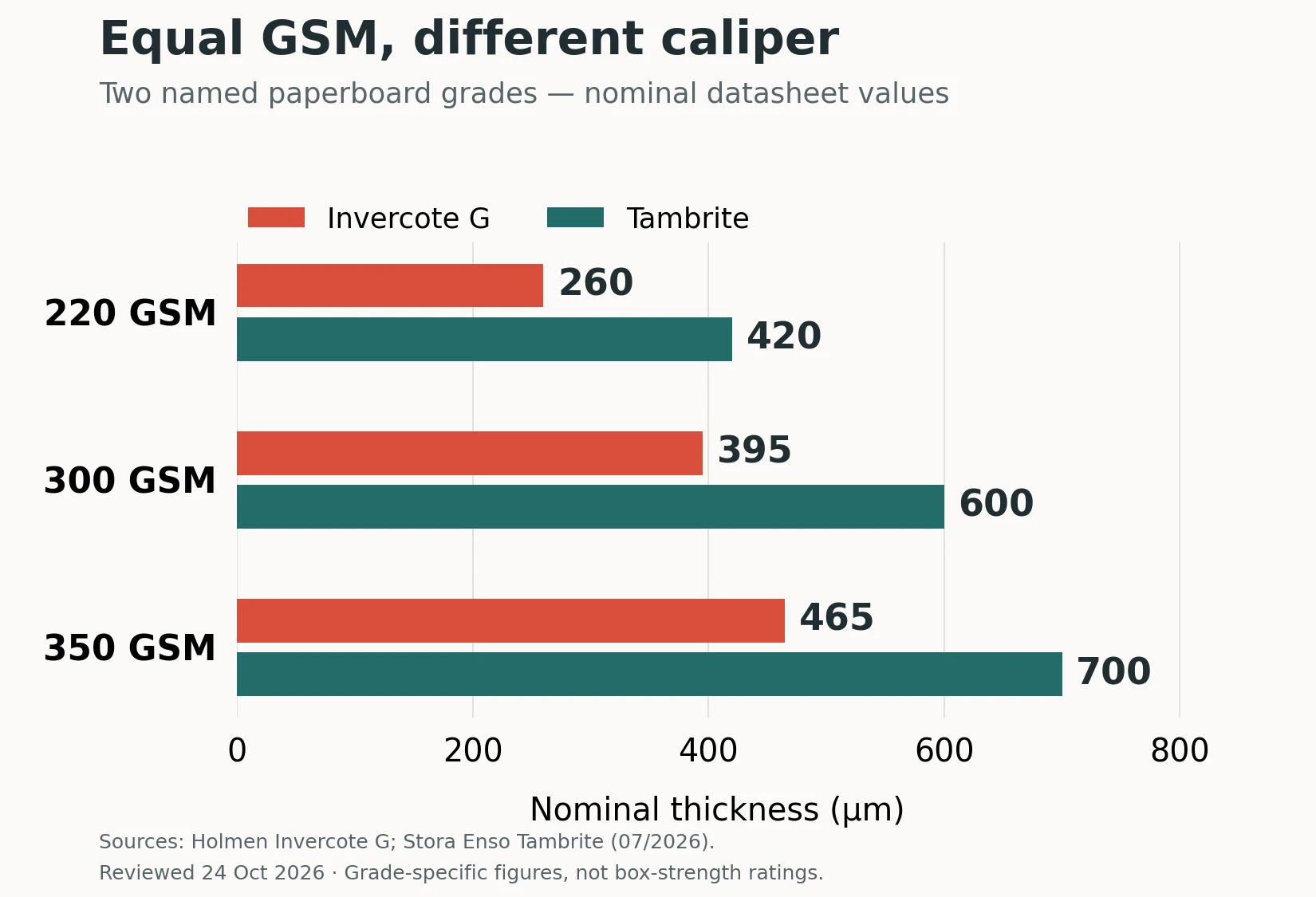
| Grammage | Invercote G: nominal caliper | Tambrite: nominal caliper |
|---|---|---|
| 220 g/m² | 260 µm / 0.260 mm | 420 µm / 0.420 mm |
| 300 g/m² | 395 µm / 0.395 mm | 600 µm / 0.600 mm |
| 350 g/m² | 465 µm / 0.465 mm | 700 µm / 0.700 mm |
At 350 GSM, the published nominal calipers differ by 235 µm, or 0.235 mm. A generic conversion chart would hide that difference. It could matter when checking a tight sleeve, a tuck closure or a construction with several folded layers.
These are nominal mill figures with source-specific tolerances and test conditions. Holmen lists a ±4% thickness tolerance; the Tambrite sheet states a maximum ±20 µm thickness tolerance for grammages of 300 g/m² and above. Consult the current specification for its scope. The examples do not establish finished-box load capacity, and do not imply that YiHongBox stocks or uses these grades in every order.
Which units can you convert—and which need material data?
You can convert µm, mm and packaging pt because all three describe length. In paperboard caliper, one point is one thousandth of an inch: 1 pt = 0.0254 mm = 25.4 µm. This is the packaging thickness convention, not the typographic point used to size fonts. The paired µm and pt entries in Holmen’s technical sheet provide a practical cross-check, with its pt figures rounded.
| Packaging caliper | Millimetres | Micrometres |
|---|---|---|
| 16 pt | 0.4064 mm | 406.4 µm |
| 18 pt | 0.4572 mm | 457.2 µm |
| 20 pt | 0.5080 mm | 508.0 µm |
| 24 pt | 0.6096 mm | 609.6 µm |
You cannot directly convert GSM to mm without information about the material. Likewise, “20 pt” does not determine a single GSM. Ask the supplier for that grade’s specification instead of selecting a board from a universal calculator. If a quotation uses pounds, also ask which basis-weight system and sheet size it refers to; “lb” alone is not a complete cross-market specification.
Choose board in five steps, starting with the box’s job
1. Identify what the pack must do
Start with the fully packed product, its dimensions and how the package is handled. A narrow cosmetic carton, a wide gift-set carton and an outer parcel shipper create different demands. Record the product weight and unsupported panel spans, plus any insert that supports the contents. A GSM number alone cannot establish whether the design will work.
2. Name the construction before comparing numbers
For a folding carton, specify the folding board itself. For a wrapped rigid box, distinguish the structural greyboard core from the thin printed wrapping paper and any lining. For corrugated packaging, specify the flute and board construction rather than treating a liner’s GSM as the thickness of the whole sheet.
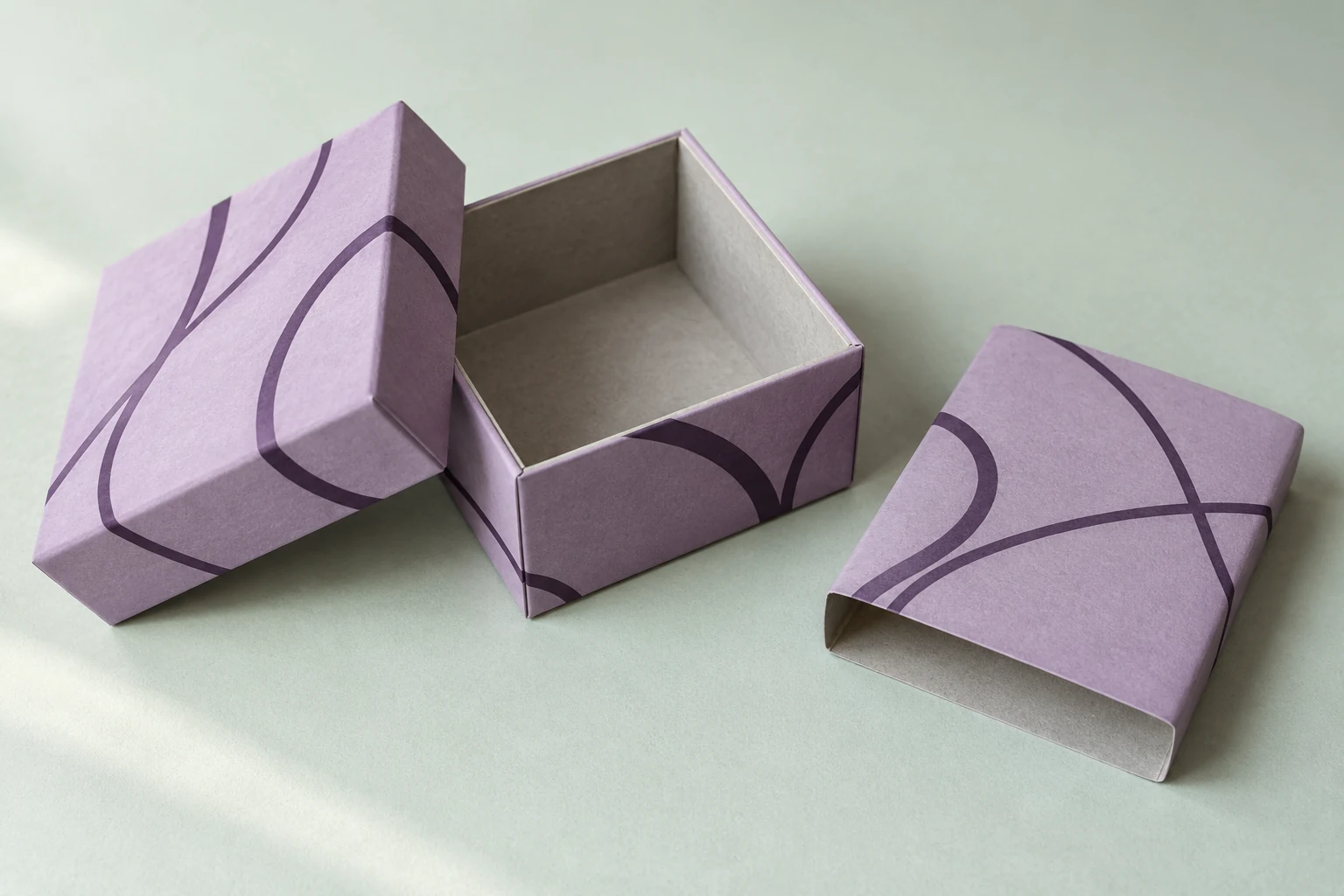
This distinction matters when comparing rigid boxes and folding cartons. A large GSM figure for a rigid core does not make it a substitute for a foldable retail board. For mailers, use our separate E-flute versus B-flute guide; do not apply the solid-board thickness table above to corrugated material.
3. Request the grade, caliper and relevant performance data
Ask for the board maker and grade, grammage, nominal caliper, tolerance and coating description. If the supplier proposes an alternative, request a side-by-side comparison using the same units and test method. “Same GSM” is not enough evidence that the alternative is suitable for your existing dieline.
4. Confirm the finished construction on a physical sample
Have the sample made to the intended dimensions with the proposed board, creases and finish. Insert the actual product, close the pack and examine the panels and closure. A flat swatch helps assess surface feel; it cannot show how a wide carton will bow or how several layers will meet at a folded corner. A fitted box insert can change how the contents are supported, so assess it with the carton.
5. Freeze the approved material and substitution rule
Record the grade and approved sample reference. State that a change in board maker, grade, caliper or finish needs approval before production. A supplier may have a workable replacement, but it should be assessed against the package’s function rather than silently accepted because the printed GSM is unchanged. Use our repeat-order specification sheet for the wider order record.
Why a thicker board can still need a different crease
Increasing caliper changes the material that must bend at a fold. A crease that works for one grade may not give the same appearance or closing behaviour with another. Holmen’s technical guidance on creasing and folding explains how board construction and the creasing setup work together. Material selection should therefore include the converted pack, not just its flat-sheet thickness.

For a small carton, inspect the top tuck and the corner where several flaps overlap. For a wide box, check whether the large front face stays acceptably flat when filled. For a sleeve, check sliding fit after the surface finish is applied. These are different acceptance questions; a single “premium thickness” label cannot answer all of them. Keep material approval connected to the current folding-carton dieline.
Compare material proposals before comparing unit prices
Two prices are comparable only when the proposed packs meet the same requirements. Use this short material-equivalence check when one supplier offers “350 GSM white card” and another names a specific grade with a caliper. Missing information is a reason to ask a question, not proof that the cheaper or heavier option is unsuitable.
| Check | Request from each supplier | Why it matters |
|---|---|---|
| Material identity | Mill/grade or a clearly defined proposed equivalent | Prevents a broad material name from hiding a different construction. |
| Grammage and caliper | Both numbers, their units and tolerances | Separates sheet mass from physical fit. |
| Measurement scope | Base board or finished coated/laminated material | Avoids comparing different stages of the pack. |
| Directional properties | MD/CD and matching test methods when needed | Makes bending-property comparisons meaningful. |
| Surface and finish | Coated sides, print process and intended treatment | Connects the material proposal to the finished appearance and fold. |
| Approval evidence | A retained finished sample and identified revision | Defines the physical reference for production and substitutions. |
A board change can also affect the printed appearance, so review the proposed material alongside the approved packaging colour and proof plan. A nominally matching white board is not automatically an identical print surface.
A material request you can send to a supplier
Please identify the proposed board grade and state its grammage in g/m², nominal caliper in µm or mm, and applicable tolerances. Confirm whether the caliper describes the base board or the finished material. Explain any proposed substitution and provide comparable data. Please make the approval sample using the proposed board, current dieline and intended finish, and obtain approval before changing those components.
How were the paperboard figures compared?
For this guide, YiHongBox compared the published nominal calipers for Invercote G and Tambrite at three shared grammages: 220, 300 and 350 g/m². The chart reproduces those grade-specific figures; it is a desk comparison of manufacturer specifications, not a laboratory test of physical sheets or finished boxes. The Holmen grade page and Tambrite specification issued July 2026 were checked on 24 October 2026.
Millimetre values were calculated by dividing micrometres by 1,000. The 235 µm difference at 350 g/m² is 700 minus 465 µm. The comparison does not rank bending stiffness, moisture resistance or finished-pack strength. Check the current grade sheet and agreed tolerances again when approving a purchase order.
Frequently asked questions
How thick is 350 GSM paperboard?
There is no single answer across all grades. In the specifications reviewed here, 350 GSM Invercote G is nominally 0.465 mm, while 350 GSM Tambrite is 0.700 mm. Ask for the specific grade’s current caliper and tolerance instead of treating either value as a universal conversion.
Is 350 GSM always better than 300 GSM for a box?
No. Within a named grade, higher grammage may change several properties, but suitability still depends on the construction, panel dimensions, crease, finish and product support. Confirm the functional requirement with a sample rather than approving an increase by weight alone.
Does 20 pt mean 350 GSM?
No. In packaging caliper, 20 pt equals 0.508 mm. It does not specify mass per area. A supplier must identify the material before assigning a GSM to that thickness.
Can I measure several stacked sheets and divide by the count?
Do not treat an improvised stack measurement as equivalent to the supplier’s specified board-caliper method. ISO 534 distinguishes single-sheet and bulking measurements and states that its bulking-thickness method is not suitable for board. Agree on the measurement method when the acceptance tolerance matters.
Does GSM tell me how much weight a finished carton can hold?
No. It gives sheet mass per area, not a finished-pack load rating. Structure, board properties, closures, inserts and handling conditions all enter the assessment. For protective shipping packs, agree on the relevant finished-pack tests and acceptance criteria.
Can I use these tables for a corrugated mailer or rigid box?
The mill-grade table covers two solid paperboard products. A corrugated mailer needs its own liner/flute construction and performance specification; a wrapped rigid box needs separate core and wrap specifications. Use the table to understand the distinction between measurements, not to assign every box the same board.
Turn the material choice into a sample-ready brief
Send YiHongBox the packed product dimensions and weight, intended box structure, finish and the material proposal you want to compare. We can provide free structural and artwork-placement guidance and quote a charged physical sample. Standard production starts at 1,000 units per size and printed design. Sampling typically takes about 7 days after specifications are agreed; bulk production typically takes about 30 days after final sample and artwork approval. Confirm the actual project schedule and any DDP delivery to the US, Canada or Australia in the quotation.