Have you ever held a box and thought, “Why does this flap fold so cleanly? Or how did they make those windows or fancy shapes?” The magic behind many of those custom touches is die cutting (or die cuts). In the post below, you and I will take a friendly stroll through the world of cutting dies, die cutters, and how die cut packaging comes alive.
By the end, you’ll be able to confidently answer “what is die cut in packaging?” when someone asks — and maybe even chat confidently with a manufacturer.
Quick answer: Die-cut packaging uses a custom cutting die to cut and crease paperboard or corrugated board into repeatable shapes, windows, locking tabs, perforations, and inserts. For buyers, the right method depends on material, run volume, tolerance, artwork registration, and tooling budget. Yihong Box supports dieline review, sampling, and custom packaging boxes from MOQ 1,000, with DDP shipping available. Explore our custom box inserts or contact us for a structural packaging quote.
A Friendly Intro to Die Cutting
At its simplest, die cutting is a manufacturing process in which a tool (called a die) is used to slice, cut, shape, or crease a material (paper, cardboard, plastic, etc.) into a desired form. Think of a cookie cutter, but instead of dough, you’ve got sheets of paperboard, corrugated board, or other packaging materials.
In packaging, and especially custom boxes, die cutting allows makers to produce unique shapes, windows, perforations, and fold lines with precision and repeatability.
Key Terms You Should Know
| Term | What It Means | Why It Matters |
|---|---|---|
| Cutting die / die | The actual tool or blade (usually custom-made) that does the cutting, perforating, scoring, etc. | It defines the shape, and its quality affects the precision and consistency. |
| Die cutter / die cutting machine | The press or machine that presses the die into the material. | Determines speed, consistency, and what kinds of materials you can work with. |
| Die cut packaging / die cut boxes | Packaging that has been formed or cut by a die. | Gives you custom shapes, windows, or intricate structural elements. |
| Printing die / paper die cutting | When cuts or shapes are integrated with printed materials (labels, folded cartons, etc.). | Combines visual design and structure in one workflow. |
| Die cutting manufacturing | The industrial process of scaling up die cutting (tooling, mass production, quality checks). | This is where cost, efficiency, and precision get serious. |
Several sources describe die cutting as a way to “convert stock material by cutting, forming, and shearing” using specialized tools. In packaging contexts, you’ll often see “die cutting and creasing” because many operations don’t just cut — they also crease (make fold lines) or perforate.
Why Use Die Cutting in Packaging?
You might ask: why go through the trouble of creating a die and using a die cutter tool? Why not just cut by hand or use standard box shapes? Here’s where die cutting shines:
1.Precision & Repeatability
Once your cutting die is made, it can reproduce the same shape over and over with tight tolerances. This consistency is crucial for high-quality packaging.
2.Complex Shapes & Details
You can add windows, cutouts, locking tabs, perforations, and more — things that are hard or impossible by manual cutting.
3.Efficiency & Scale
For medium to large runs, die cutting is efficient. Although the upfront cost of making a die is nontrivial, over thousands of units it becomes economical.
4.Material Optimization & Waste Reduction
Designers can “nest” (arrange) die shapes tightly to minimize waste of the raw sheets.
5.Brand and Aesthetic Value
Die cut boxes give your product wow factor — custom shapes, windows, creative perforations, etc., all elevate the unboxing experience.
6.Integrated Printing & Structure
You can combine the structural work (folds, cuts) with printed graphics, so your box is both well-designed and attractive.
Defining More Than Just Cutting — The "Dimensional Leap" from 2D to 3D
In 2026’s packaging engineering, die-cutting is the soul. It is the “digital version of origami” that transforms flat paper into a brand container with character. Die-Cutting is not just about cutting outlines; it is a precision combination of Creasing, Perforating, and Cut-outs.
Structural Dignity at the Millimeter Level: We utilize the latest 2026 high-precision dies, controlling tolerances within 0.1mm. This precision ensures that no matter how complex the irregular shape is, it assembles with a perfect mechanical fit, granting the brand a professional sense of “seamless integration.”
Windowing & Visual Storytelling: Die-cutting creates not just boxes, but visual gateways. Through precision cut-out crafts, packaging can interact cleverly with the internal product, transforming the packaging itself into an interactive marketing medium.
The Die Cutting Process: Step by Step
Let’s walk through how a box or package gets made with die cutting.
1.Design & Dieline Creation
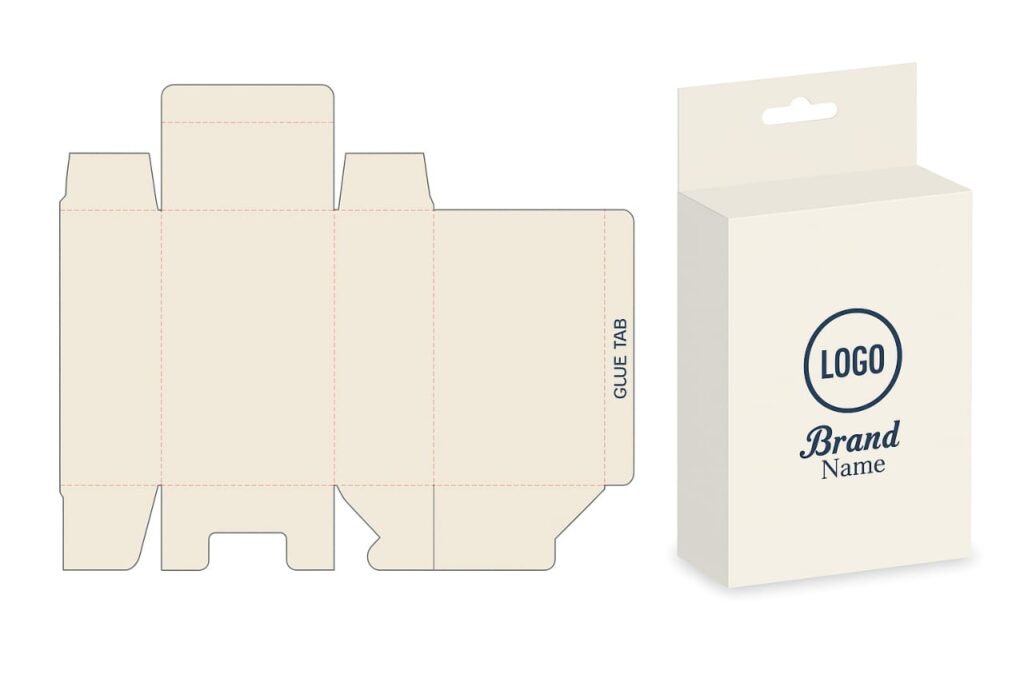
- The designer creates a dieline(a flat layout) showing cut lines, fold (crease) lines, bleed, safe zones, etc.
- This is often done in software (e.g. ArtiosCADis a common tool used in the packaging industry).
2.Die Making (Tooling)
- From that dieline, the actual die(cutting tool) is built. This could be a steel rule die, laser-cut plates, rotary dies, or adjustable dies depending on complexity.
- The die often consists of blades, creasing rules, perforating elements, and support structures.
3.Setup & Calibration
- The die is mounted into or aligned with the die cutter tool or press.
- Pressure, alignment, and registration are calibrated (especially critical when combining cutting with printed graphics).
4.Cutting / Scoring / Creasing
- Through cuts: cutting all the way through the material.
- Scoring / creasing: partial cuts or indentations to make folding easier.
- Perforations: small cuts so that parts can be torn or folded easily.
- The machine presses the die into the material firmly to perform these operations.
5.Matrix Removal & Clean-up
- The “waste” or leftover pieces (matrix) are removed or stripped away, leaving behind the desired shape(s).
- Scrap is usually collected, recycled, or reused when possible.
6.Folding, Gluing & Finishing
- After die cutting, some parts are folded, glued, or assembled as needed.
- Further finishing touches like embossing, UV coating, foil stamping, or laminations may be applied.
7.Quality Inspection & Packaging
- A final quality check ensures cuts are clean, folds are sharp, and everything lines up.
- Then products are packed and shipped.
Because of this sequence, die cutting is sometimes done inline (in the same machine line as printing) or offline (as a separate step).
For corrugated projects, FEFCO’s official production-process overview explains how printing, die cutting, folding, and gluing fit into the converting workflow.
Types of Die Cutting Methods
Not all die cutting is the same. Depending on volume, material, and design complexity, manufacturers may use different techniques:
| Method | Best For / Advantages | Trade-offs / Limitations |
|---|---|---|
| Flatbed Die Cutting | Low to medium runs, thick materials, very precise work. | Slower, less suited for web/continuous runs. |
| Rotary Die Cutting | High-volume, continuous operations; often inline with printing. | Higher tooling cost, less flexibility for quick design changes. |
| Semi-Rotary (Hybrid) | Good compromise — allows some web movement with rotary dies. | More complex machine, design constraints. |
| Digital / Laser Die Cutting | Excellent for prototyping, short runs, highly detailed cuts. | Slower for large volumes, higher per-unit cost in large runs. |
So if you’re just experimenting with a new box design, digital die cutting could be a perfect fit. But if you’re ordering 10,000 units for your product shelf, rotary or flatbed die cutting is more realistic.
Die Cut Boxes: What Makes Them Special?
When you hear die cut boxes, think of boxes that are cut, folded, and formed from a single sheet of material using the die cutting process. These aren’t “glued tube boxes” — they often include flaps, interlocking tabs, perforated panels, and windows, all built right into the cut.
Some advantages of die cut boxes:
- They ship flat (saving space) and fold easily.
- They often require minimal tape or glue in assembly.
- They can include embellishments — windows, cutouts, die cut shapes — to enhance branding.
- They are customizable to the product shape, reducing waste inside padding.
In the corrugated world, tooling (i.e. the cutting die and print plates) is foundational to manufacturing.
Challenges & Things to Watch Out For
Die cutting is powerful — but not without trade-offs or complications. If you’re diving into this, keep these points in mind:
High Upfront Cost for Dies
The die-making process (steel rule dies, laser cuts, etc.) is nontrivial in cost. But it becomes cost-effective for large runs.
Design Constraints
Very sharp internal corners or razor-thin tabs may tear or be difficult to die cut. Designers must leave enough material around features.
Material Variation
Different papers, thicknesses, coatings (e.g. lamination) behave differently under pressure. The die must be tuned accordingly.
Tool Wear & Maintenance
Repeated use wears down blades, especially in tougher materials. Dies must be rechecked, sharpened, or replaced periodically.
Registration & Precision
When combining printing with die cutting, aligning the cuts perfectly over printed graphics (registration) is challenging.
Waste Management
Even with nesting, some waste is inevitable; recycling or reusing matrix material helps.
Run-length Considerations
For very short runs, the cost of the die might overwhelm the benefits. That’s where digital or laser die cutting shines.
Real-World Applications & Use Cases
Die cutting is everywhere — even if you don’t notice it. Here are some common uses:
- Folding cartons / retail boxes: Think cosmetics, electronics, food packs.
- Windowed packaging: Boxes with a plastic film window to show the product.
- Inserts & trays: Custom trays or die-cut insertsthat fit inside a box.
- Labels & stickers: Die-cut labels in custom shapes.
- Promotional packaging & point-of-sale displays: Creative shapes that stand out.
- Perforated tear strips: Easy-open tabs or coupon perforations.
- Specialty gift boxes / premium packaging: Embellished and custom structural designs.
Because die cutting can integrate with graphic printing lines (especially in flexographic or digital printing workflows), many packaging houses run printing + die cutting inline for maximum efficiency.
Example: Die Cutting vs Other Methods
Let’s illustrate via a simple example:
Say you want a box with a die-cut window in front, plus a foldable flap and locking tab.
- Without die cutting: You might need to pre-cut the flat sheet manually, rely on hand-folding, glue, or standard box shapes. The window might get cut later separately.
- With die cutting: You design one dieline (with window, flap, tabs). You make one die. The machine handles the cut, score, crease, and perforations in one go. You get perfectly aligned windows and folds, repeated consistently.
Tips If You’re Working with a Packaging Supplier
- Ask to see their die cuttingcapabilities (flatbed, rotary, digital).
- Provide a clean dieline and clearly mark cut lines, fold lines, perforations, and safety zones.
- Ask for prototypes first before committing to large runs.
- Inquire about die lifespan and maintenance (how many uses until you need repair).
- Think about future variants/design changes: keep some parts modular so you don’t always have to remake the entire die.
- Request nested layouts to minimize material waste.
- Confirm registration tolerances if your design has very precise alignment of cuts over printed graphics.
FAQ
How do I choose between traditional steel-rule die-cutting and 2026 digital laser cutting for optimal cost?
It depends on your order volume and design complexity. Steel-rule Die-cutting requires upfront tooling costs, but for bulk orders exceeding 2,000 units, its unit price advantage is unmatched and the speed is exceptional. 2026 Digital Laser Cutting requires no die costs, making it useful for physical prototypes or designs with intricate cut-outs. YiHongBox production orders start at 1,000 units per design; pre-production samples are quoted separately. If your brand needs to test market reactions frequently, the digital solution is the go-to for an “agile supply chain.”
Why do die-cut packages sometimes develop cracks when folded? How do you solve this?
This is typically caused by a mismatch between die-cutting pressure and the paper’s Fiber Orientation. Yihong Box uses AI to simulate physical paper properties before production, ensuring all critical creases are angled optimally relative to the fiber direction. Combined with the latest 2026 Micron-level In-line Humidification systems, we increase fiber flexibility, ensuring the printed surface remains smooth and intact even under sharp 180° folds, with zero cracking.
Does your die-cutting process support ultra-thick materials (like heavy corrugated or greyboard over 3mm)?
Yes. For ultra-thick materials, we utilize Heavy-duty Hydraulic Die-cutting systems. While standard equipment often causes edge deformation when handling thick boards, our system ensures neat cuts and sharp right-angles through vertical blade pressure control. This is vital for the large-scale electronic packaging or heavy-duty gift boxes popular in 2026.
Will complex die-cut shapes (like cut-outs or irregular edges) reduce the box's compression strength?
In 2026 structural design, aesthetics and strength are no longer a zero-sum game. Yihong Box utilizes “Mechanical Support Balanced Design.” By creating hidden “support beams” via creasing or localized thickening around die-cut areas, we ensure that even with large windowed areas, the reduction in vertical compression strength is controlled within $5\%$, ensuring logistical safety.
Regarding the 2026 "Minimalist Unboxing" trend, how can die-cutting help improve the user experience?
We recommend integrating “Perforated Tear-strips.” By precisely controlling the skip-blade spacing (accurate to $0.05 \text{ mm}$), we create tear-strips with a silky feel and precise pathing. This design not only replaces ugly transparent tape but also grants the user a crisp unboxing ritual, which is key to boosting the brand’s “unboxing ASMR” value.
Will the die-cut creases experience fiber breakage or fading after multiple folds?
This is an engineering advantage of Yihong Box. We utilize Graded Creasing, dynamically adjusting crease depth based on paper weight. Combined with toughness-enhanced finishes, we ensure creases remain color-saturated and structurally sound even after thousands of cycles, eliminating “edge bursting.”
A frequently asked question surrounding your service
A detailed answer to provide information about your business, build trust with potential clients, and help convince the visitor that you are a good fit for them.