
I. Introduction: The Ultimate Packaging Dilemma
Every procurement manager and product developer eventually faces the same crossroads before launching a new product line: How do we balance the desire for ultimate brand luxury with the brutal reality of supply chain costs, which McKinsey reports have been increasingly volatile?
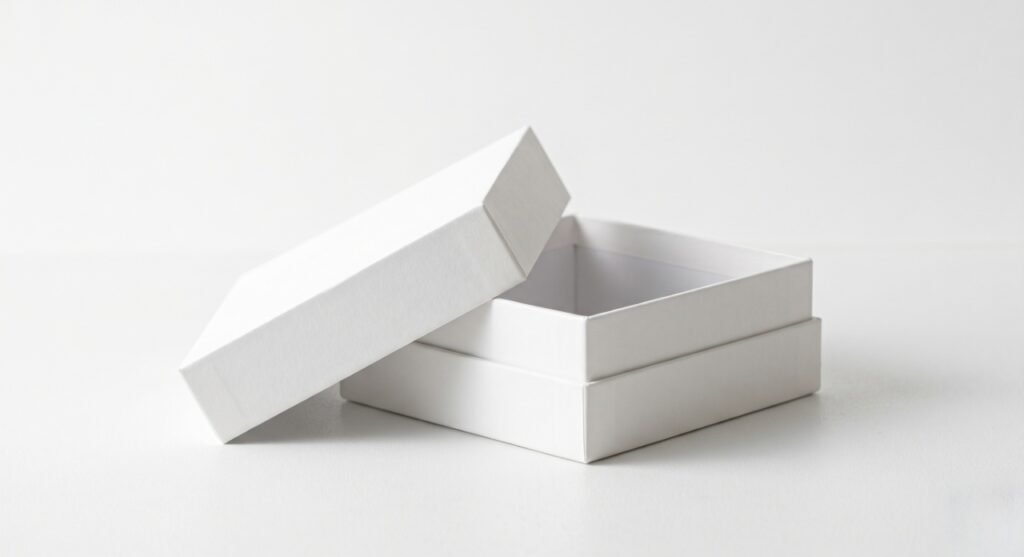
When you are tasked with sourcing custom packaging, the primary debate almost always comes down to two heavyweights: Custom Rigid Boxes versus Premium Folding Cartons. One offers an uncompromising, “gift-ready” unboxing experience, while the other offers unmatched logistical agility and cost-efficiency.
There is no universal best structure. Rigid boxes prioritize premium presentation and long-term reuse, while folding cartons prioritize flat shipping, packing speed and lower storage volume.
Rigid Box vs Folding Carton Buyer Checklist
Compare custom rigid boxes, folding box options and the wider custom packaging process using product value, packed weight, annual volume and fulfillment constraints.
- Rigid box: choose when presentation, fitted inserts and structural permanence justify higher freight volume.
- Folding carton: choose when flat delivery, automation and cost efficiency are priorities.
- Transit: validate the final pack with relevant ISTA test procedures.
- Environmental brief: reference ISO 18601 and document paper claims through FSC chain of custody.
YiHongBox supports structural comparisons, prototypes and DDP delivery from MOQ 1,000. Request a packaging structure recommendation.
II. Deep Dive: The Luxury of Custom Rigid Boxes
When you picture the packaging for a Rolex watch, a high-end smartphone, or a $200 jar of La Mer face cream, you are picturing a rigid box.
What is it? Unlike standard folding cartons, custom rigid boxes are constructed from highly compressed, thick paperboard (typically 1000GSM to 1200GSM greyboard). This sturdy core is then seamlessly wrapped in specialty textured papers, premium faux leather, or soft-touch laminations. They do not fold or collapse.

The Pros: Why Brands Choose Rigid Boxes
-
Unmatched “Gift-Ready” Unboxing : Rigid boxes provide a substantial, weighty feel in the hands of the consumer. The satisfying friction of a two-piece lid sliding off, or the crisp “snap” of a magnetic closure, subconsciously communicates premium product quality.
-
High Retention Rate : End-consumers rarely throw away high-quality rigid boxes. They are repurposed for home organization or jewelry storage, providing your brand with years of free secondary exposure in the customer’s home.
-
Zero Assembly Required : Because they are manufactured and shipped fully assembled, your warehouse fulfillment team simply places the product inside and ships it out. There is no time wasted folding flaps or taping bottoms.
The Cons: The Hidden B2B Costs
-
The Dimensional Weight Trap : This is the biggest hurdle. Because rigid boxes cannot be shipped flat, they take up massive amounts of space. With major carriers enforcing strict dimensional weight (DIM weight) pricing, you are essentially paying to ship empty air when importing these via ocean or air freight, making the landed cost significantly higher.
-
Higher Unit Price & Longer Setup : The manufacturing process involves more manual labor and complex machine setups to glue and wrap the paper around the greyboard, resulting in a higher minimum order quantity (MOQ) and a higher cost per unit.
III. Deep Dive: The Agility of Premium Folding Cartons
When people hear “folding cartons,” they sometimes mistakenly think of flimsy, generic shipping boxes. In reality, Premium Folding Cartons are the agile workhorses of the modern luxury supply chain.
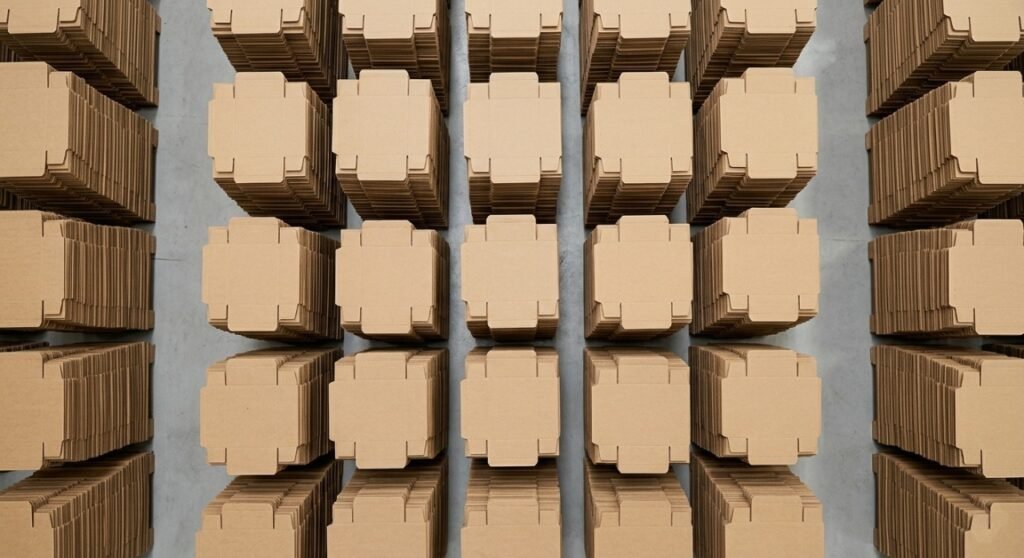
What is it? These boxes are typically die-cut from a single sheet of high-quality, dense paperboard (such as 300GSM to 400GSM SBS board or natural Kraft). Through precise engineering, they are shipped completely flat and folded into their 3D shape only when needed.
The Pros: The Kings of Logistics and ROI
The Flat-Shipping Advantage : This is where folding cartons dominate. Because they ship completely flat, you can pack thousands of them onto a single pallet. This dramatically slashes your international ocean or air freight costs and minimizes the monthly storage fees at your fulfillment center.
Cost-Effective & Scalable : The manufacturing process is highly automated. There is no manual gluing or wrapping required. This results in significantly lower tooling costs, lower unit prices, and much faster turnaround times, making them ideal for agile brands testing new markets.
Eco-Friendly by Nature : Made from a single layer of paperboard, they are incredibly lightweight (reducing carbon emissions during transport) and, according to EPA recycling data, are generally much easier for end-consumers to recycle in their curbside bins.
The Cons: The Fulfillment Trade-off
-
Assembly Labor Required : The trade-off for cheap shipping is warehouse labor. Your fulfillment team must fold and assemble each box before packing the product. (Note: This can be mitigated by upgrading to an “Auto-Bottom” crash-lock design, which pops into shape in 3 seconds).
-
Weight Limits & Perceived Value : While they can be printed beautifully, a folding carton will never feel quite as heavy or “expensive” as a thick rigid box. They are also not suited for holding extremely heavy luxury items (like large glass liquor bottles) without heavy-duty internal inserts.
IV. The Ultimate Showdown: A Side-by-Side Comparison
To make your procurement decision as clear as possible, we have broken down the critical B2B metrics into a side-by-side comparison.
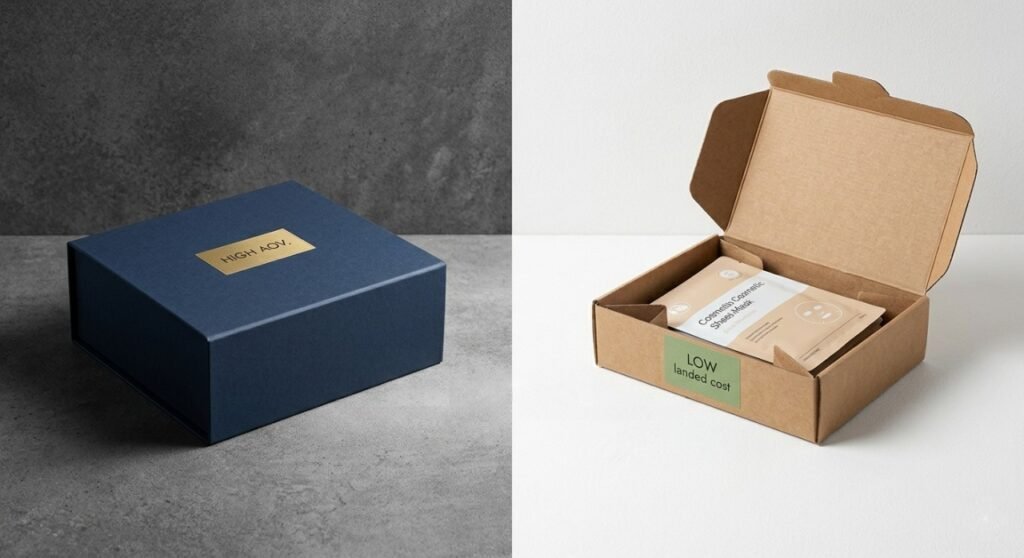
Whether your priority is maximizing unboxing luxury or minimizing landed costs, this table reveals exactly how each box performs in the real world of supply chain management.
B2B Packaging Metrics Comparison
| Comparison Metric | Custom Rigid Boxes | Premium Folding Cartons |
Logistics & Freight Cost
| Very High 🔴 Ships pre-assembled; you pay to ship empty air. | Very Low 🟢 Ships flat; maximizes pallet density. |
Warehouse Storage Space
| High 🔴 Requires massive warehouse shelving space. | Low 🟢 Stacks completely flat in a fraction of the space. |
Manufacturing Unit Price
| Higher 🟠 Requires manual labor for wrapping and gluing. | Lower 🟢 Highly automated die-cutting process. |
Assembly / Fulfillment Labor
| Zero ($0) 🟢 Ready to pack immediately. | Moderate 🟠 Requires warehouse staff to fold into shape. |
Unboxing Luxury & Retention
| Premium / Keepsake 🟢 Heavy, gift-ready, often kept by consumers. | Standard to High 🟠 Excellent aesthetic, but generally discarded after use. |
Structural Weight Capacity
| Heavy-Duty 🟢 Safely holds heavy glass, cosmetics, and electronics. | Light to Medium 🟠 Best for lighter apparel, sheet masks, or supplements. |
V. Industry Matchmaker: Which Box Wins in Your Sector?
Data and specifications are helpful, but B2B procurement ultimately comes down to your specific product and target audience. Let’s look at how the Rigid vs. Folding debate plays out across major retail sectors.
1. Fine Jewelry & Luxury Watches
The Winner: Custom Rigid Boxes 🏆
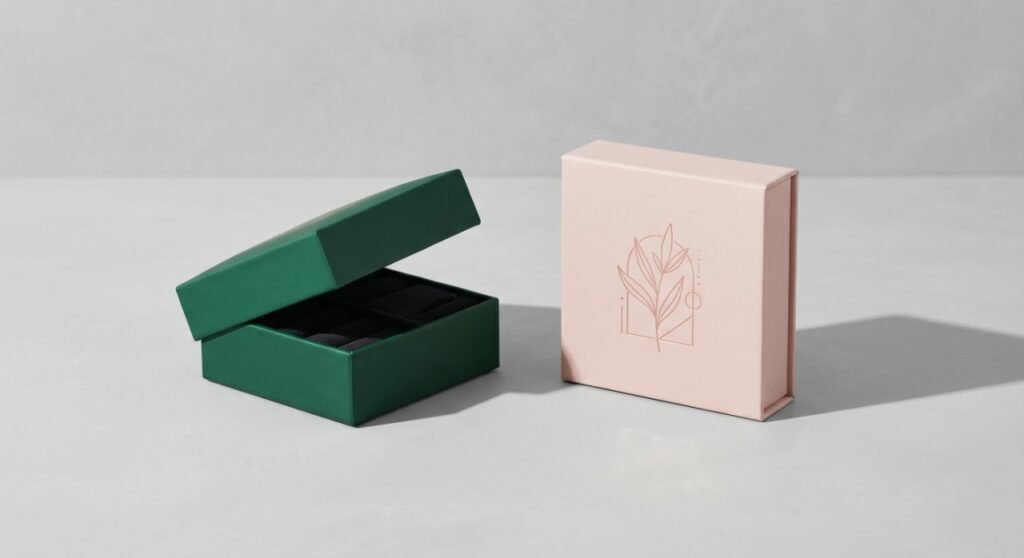
The Logic: When a customer is spending $500 or $5,000 on a product, the packaging must reflect that massive Average Order Value (AOV). Furthermore, custom jewelry packaging boxes are physically small, meaning the “dimensional weight” penalty during ocean or air freight is minimal. The uncompromising luxury of a rigid box is non-negotiable here.
2. FMCG Beauty & Sheet Masks
The Winner: Premium Folding Cartons 🏆
The Logic: As noted in industry analyses on FMCG supply chains, Fast-Moving Consumer Goods (FMCG), especially within our custom cosmetic packaging portfolio, rely on high sales volume and strict profit margins. These products move quickly off retail shelves and require massive inventory. The flat-shipping nature of folding cartons ensures your logistics budget isn’t eaten alive, while high-quality offset printing still ensures the boxes pop on the shelf.
3. Luxury Skincare Sets & Heavy Glass Jars
The Winner: Custom Rigid Boxes 🏆
-
The Logic: A set containing heavy glass serum bottles and thick cream jars requires serious structural integrity. A standard folding carton might buckle under the weight during transit. A rigid box, paired with a custom high-density EVA foam insert, guarantees the product survives international shipping without a single scratch.
4. Gourmet Food, Tea & Chocolates
The Winner: Premium Folding Cartons (with Window Patching) 🏆
The Logic: Food packaging requires strict adherence to FDA-compliant, food-safe material regulations. Premium folding cartons made from SBS board are perfect for this. Adding a die-cut PET window allows consumers to see the artisanal chocolates or tea leaves inside, driving impulse purchases without needing the heavy structure of a rigid box.
VI. The "Hybrid" VAVE Strategy: Elevating the Folding Carton
What if your budget dictates that you must use folding cartons to save on shipping, but your brand positioning demands the feel of a luxury rigid box?
At Yihong Packaging, our structural engineers frequently employ a Value Analysis/Value Engineering (VAVE) Hybrid Strategy. We upgrade specific elements of a flat-packed carton to mimic the weight and sensory experience of a rigid box.
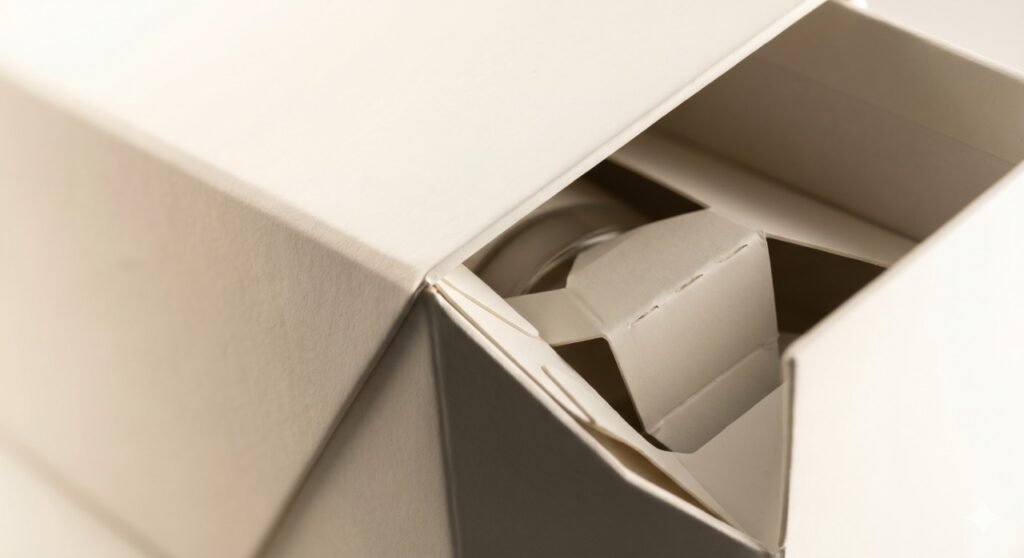
Here is how we close the gap:
1. Upgrade the Core : Instead of standard 300GSM board, we step up to 400GSM or 450GSM high-density paperboard. This minor increase in material cost drastically increases the stiffness and “snap” of the box, making it feel significantly more substantial in the hand.
2. The Internal “False Bottom” Insert : A folding carton feels cheap when it feels hollow.By engineering custom packaging inserts (like precision die-cut cardboard) that securely hold the product, we add immense internal structural support. The box no longer compresses when squeezed, giving it the rigid stability of a much more expensive box.
3. Sensory Finishes over CMYK : We shift the budget away from full-color printing and invest it in premium surface finishes. Applying a Soft-Touch Lamination… makes the carton feel like rose petals, while a sharp, deep Blind Deboss or metallic foil on the logo provides the high-end tactile experience consumers expect from rigid packaging.
VII. Tooling & Setup Costs: The Hidden Capex
When sourcing B2B packaging, many procurement managers focus entirely on the “Unit Price” while overlooking the initial Capital Expenditure (Capex) required to get the manufacturing line running.This hidden cost—often referred to as tooling, molds, or setup fees—varies wildly between rigid boxes and folding cartons.
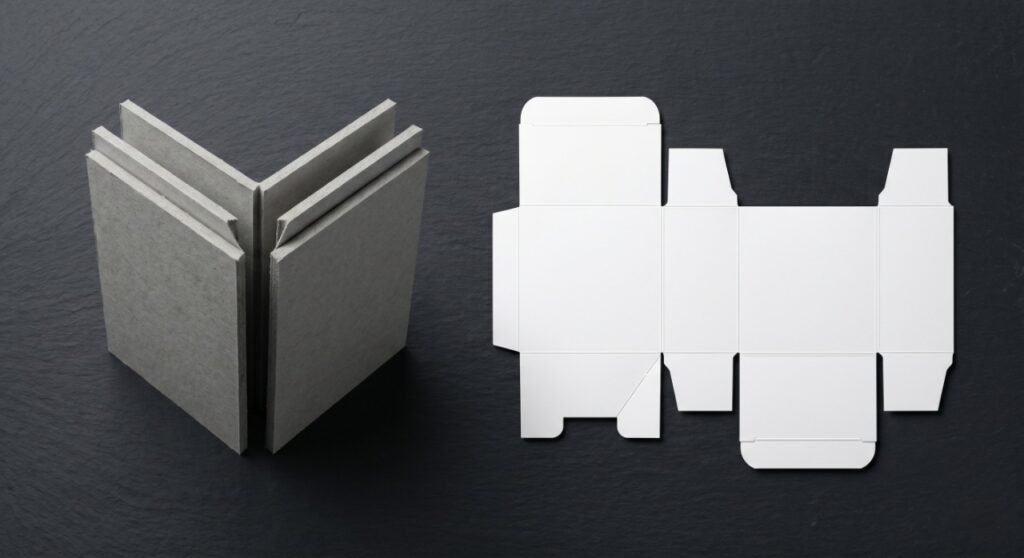
1. Custom Rigid Boxes: High Initial Investment
Manufacturing a rigid box is a multi-step, heavy-duty process. It involves V-grooving thick greyboard, precisely die-cutting the outer wrapping paper, and calibrating automated gluing machines to assemble the box perfectly.
The Reality : The machine setup time is significantly longer. Furthermore, if your rigid box requires a custom thermoformed plastic tray or an injected EVA foam insert, you must pay for expensive 3D physical molds.
The Verdict : Rigid boxes carry a high initial setup cost. They are best suited for stable, long-term product lines (Hero SKUs) where the mold costs can be amortized over tens of thousands of units across multiple years.
2. Premium Folding Cartons: The Agile Champion
Folding cartons are incredibly lean to set up. Once the structural design is finalized, the factory only needs to produce a simple wooden and steel cutting die (dieline).
The Reality: Creating a cutting die is fast and inexpensive. Machine calibration for die-cutting and auto-gluing takes a fraction of the time compared to rigid box assembly.
The Verdict : Folding cartons have minimal hidden Capex. They are the ultimate choice for agile brands, seasonal limited editions, or D2C startups that need to frequently update their packaging designs without bleeding money on new molds every quarter.
VIII. Sustainability & ESG Compliance: The Green Score
By 2026, sustainable packaging solutions are no longer just a marketing buzzword; they are a strict legal requirement. With heavy Extended Producer Responsibility (EPR) regulations being enforced across Europe and North America, how do these two box types compare in their Life Cycle Assessment (LCA)?
1. Folding Cartons: The Low-Carbon, Easily Recyclable Winner
From a pure compliance and recycling standpoint, Premium Folding Cartons win the green race easily.
-
Low Transport Emissions : Because they ship flat, they require dramatically fewer trucks and cargo ships to transport, massively reducing your brand’s Scope 3 carbon footprint.
-
Mono-Material Simplicity : A high-quality folding carton is often made from 100% paperboard (mono-material) without heavy glues. This means the end-consumer can simply toss it into their curbside recycling bin without a second thought.
2. Rigid Boxes: The "Reusability" Paradox
Rigid boxes face a unique sustainability challenge. They are composite products—made by bonding thick greyboard with glues, specialty papers, and sometimes hidden magnets. This mixed-material construction makes them incredibly difficult for standard municipal recycling plants to process.
-
The Silver Lining : While they fail the “easy recycling” test, rigid boxes excel in the Reusability Metric . Because they are so sturdy and beautiful, up to 70% of consumers keep luxury rigid boxes to use for home storage.
-
The Strategy : If you must use a rigid box, we advise brands to explicitly design them for secondary use (e.g., as a jewelry case or desk organizer) and to swap out unrecyclable foam inserts for eco-friendly molded pulp or die-cut cardboard.
IX.Conclusion & Call to Action (CTA)
In the ultimate debate between Custom Rigid Boxes and Premium Folding Cartons, there is no universal winner. Rigid boxes sell the “ultimate unboxing experience,” while folding cartons sell “commercial efficiency.”
The secret to highly profitable B2B procurement is matching the structural engineering of the box to your specific supply chain realities and brand positioning. You don’t have to sacrifice luxury for logistics, nor do you have to bleed money on freight just to look premium.
Stop guessing and start engineering. Send your product dimensions to the experts at Yihong Packaging. Our structural engineering team will provide a Free VAVE Packaging Audit, complete with a 3D digital dieline and a personalized cost-benefit analysis comparing rigid vs. folding options for your specific SKU.
FAQ
Is there a middle-ground packaging that ships flat like a folding carton but feels like a rigid box?
Yes, there is a premium hybrid known as the Collapsible Rigid Box (Magnetic Folding Box). It is constructed from the same thick 1200GSM greyboard as a traditional rigid box, but engineered with hinged corners and concealed magnets. It ships completely flat (saving you massive ocean freight costs) and instantly snaps into a premium rigid structure upon assembly. It is an excellent solution for high-end brands looking to balance luxury with logistics.
Can a premium folding carton be used directly as an e-commerce shipping box (mailer)?
We strongly advise against it. Premium folding cartons (made from 300-400GSM paperboard) are designed as primary retail packaging. They do not have the structural crush-resistance to survive the rough handling of postal networks on their own. If you need a box that serves as both the retail presentation and the shipping container, you should look into Custom Corrugated Mailer Boxes (E-flute), which offer the perfect blend of structural protection and printing capability.
Can I apply the same luxury finishes (like foil stamping or embossing) to a folding carton as I can to a rigid box?
Absolutely. The external printing surface of a premium folding carton (typically SBS board) can accept all the same high-end finishes as the specialty paper wrapped around a rigid box. You can freely apply metallic hot foil stamping, Spot UV, blind debossing, and soft-touch laminations to elevate the tactile experience of a folding carton.
Can I get physical samples of both types before committing to a bulk production run?
Yes, this is a standard best practice in Value Engineering. We highly recommend ordering a structural “white sample” (unprinted) of both a rigid box and a folding carton designed to your specific product’s dimensions. This allows your team to physically test the fit, compare the assembly time, and present both options to your stakeholders before finalizing the massive Capex of a bulk order.