
Quick answer: A 44 ECT board has a higher specified edge-crush value than 32 ECT board, but the two numbers are not safe payload ratings or a direct prediction of a finished box’s stacking strength. For a light, compact parcel, a well-designed 32 ECT box may be sufficient. A heavier or taller pack-out, higher stacking demand, or a demanding distribution route may justify evaluating 44 ECT. The final choice should be confirmed on the actual box and contents, not on the board label alone.
For packaging buyers, the useful question is not simply “Is 44 stronger?” It is “What is the lightest, most economical custom corrugated shipping box that reliably protects this product through its real route?” This guide separates board strength from finished-box performance, shows two sourced data comparisons, and gives you a practical RFQ and test plan.
What do 32 ECT and 44 ECT actually mean?
ECT stands for edge crush test. It measures how much compressive force a small sample of corrugated board resists when loaded on its edge, perpendicular to the flute direction. TAPPI/ANSI T 811 describes the short-column method used for this board-level measurement. In the customary US notation, the values are expressed in pounds-force per inch of board width: a 32 ECT designation indicates a specified minimum of 32 lbf/in, while 44 ECT indicates 44 lbf/in. The Walmart corrugated-board specification labels its minimum edge crush test column in pounds per inch of board width.
Mathematically, 44 is 37.5% above 32 as a board rating. That does not mean a 44 ECT finished box can carry 37.5% more product, withstand 37.5% more stacking load, or survive 37.5% more drops. Dimensions, design, converting quality, closure, contents and distribution conditions all intervene. ASTM D5639/D5639M-25 explicitly treats material specifications as only one part of box selection and calls for evaluation of the finished package in its distribution environment.
The 37.5% difference is an arithmetic comparison of specified edge-crush ratings, not a finished-box capacity or protection claim. Method and units: TAPPI T 811 and the Walmart specification table for the 32 and 44 ECT entries.
ECT, BCT and burst strength are different specifications
ECT characterizes the corrugated board. BCT, or box compression testing, applies a compressive load to a constructed container. TAPPI T 804 covers compression resistance of shipping containers, and ASTM D642-25 describes compression testing of shipping containers, components and unit loads. The results depend on the test setup, orientation and whether the package is empty or packed. Burst strength is a different board property; none of these numbers should be substituted for the others in a purchase order.
If flute profile is part of your decision, read our E-flute vs B-flute mailer box guide and broader corrugated box types and flutes guide. ECT grade and flute choice should be specified together with the final structure.

32 ECT vs 44 ECT: what does real-world guidance show?
Published buying tables can provide a useful starting point, but only within their stated scope. The retailer-specific Walmart corrugated-board specification lists example limits for single-wall boxes. In that table, 32 ECT appears alongside a 65 lb maximum gross weight and a 75 in maximum sum of outside dimensions (length + width + depth); 44 ECT appears alongside 95 lb and 95 in. Gross weight means the complete package and contents, not product weight alone. These are that retailer’s board-specification table entries, not universal box capacities or a substitute for engineering and testing. The same document lists separate automation-eligible case limits, so meeting this table alone does not establish approval for every Walmart handling channel.
Maximum gross package weight
Maximum outside L + W + D
Source: Walmart Corrugated Board Specifications, table for single-wall boxes. Values are retailer-specific combined limits and should not be generalized to every carton, route, or carrier.
A second data point explains why grade alone is not enough. In a Fibre Box Association technical study, researchers evaluated 21 × 15 × 16 in single-wall regular slotted containers made from both 32 ECT and 44 ECT board, with 10 replications per parameter. The association reports that score cracking reduced compression strength by more than 10% in the tested construction. This is evidence about those tested samples and production variables, not a universal penalty to apply to every box. For a buyer, the lesson is practical: ask about score quality, slotting and finished-box validation, not just the printed ECT grade.
What else changes a box’s usable strength?
- Footprint and height: A tall, narrow carton and a short, broad carton made from the same board need not behave alike under stacking. Specify the actual internal dimensions and pack-out.
- Flute and caliper: Board construction, flute profile, liner combination and thickness influence cushioning, print surface and compression behavior. Compare complete board specifications, not grade names in isolation.
- Scores, slots and joints: Creasing damage or weak joints can erode finished-box performance. ASTM’s selection guidance warns that a material specification cannot guarantee that a finished box was well made.
- Closure and contents: Tape pattern, inserts, void fill, load-sharing contents and how the package is assembled can change the result. Test the packed configuration that will actually ship.
- Storage and route: Stacking pattern, time under load, moisture exposure and handling hazards vary by channel. Validate for the intended route rather than relying on a generic grade chart.
For the structure behind many master cartons, see our regular slotted container (RSC) explainer. If the package is a customer-facing mailer rather than an RSC, also compare our custom shipping box options with the intended print finish and opening experience.
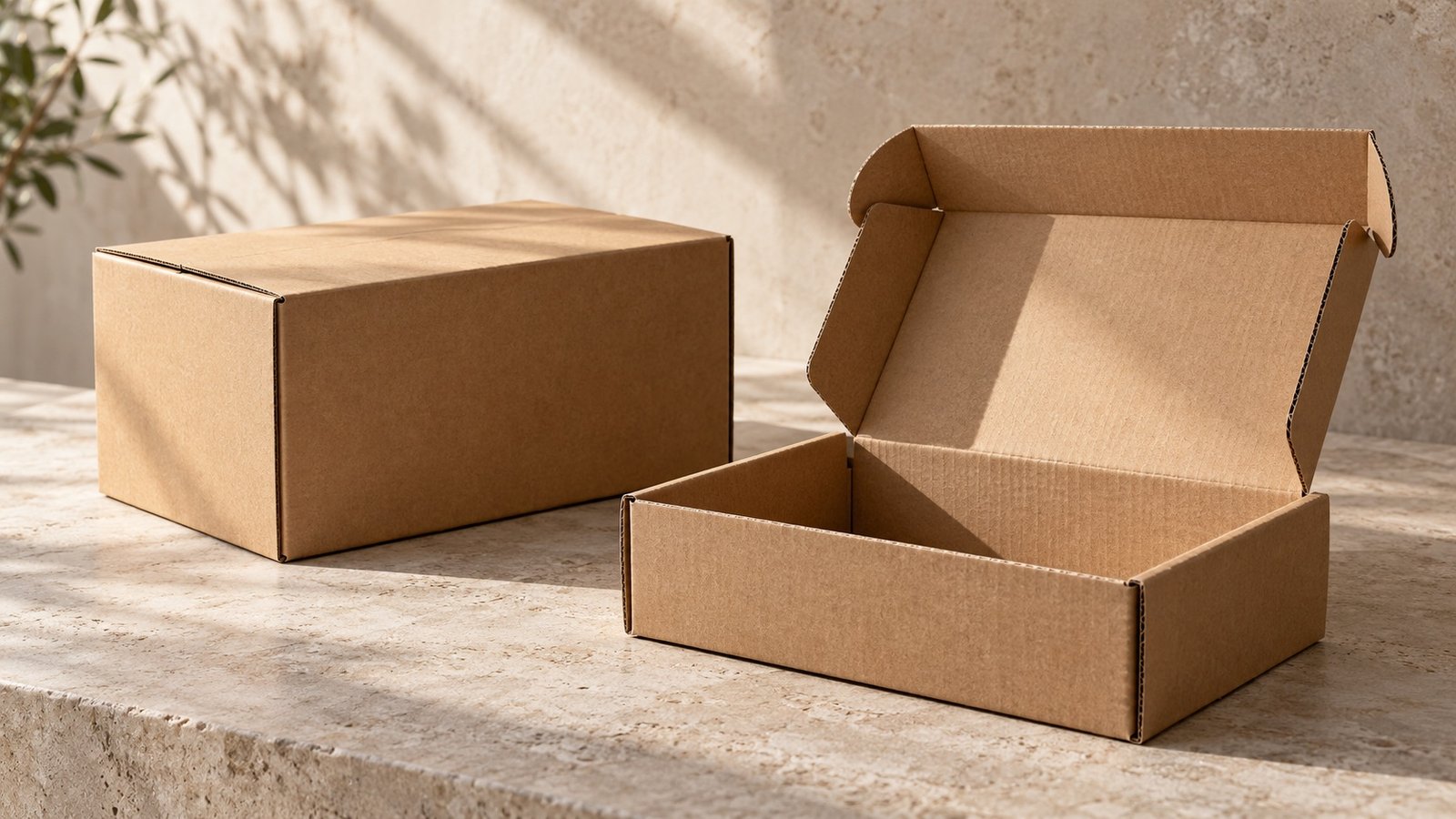
A sensible three-stage test plan
- Verify the board. Request the agreed 32 or 44 ECT board grade and an appropriate board-level test or supplier certificate. State the test method and any conditioning requirements in the purchase specification; TAPPI T 811 is one recognized edgewise-compression method.
- Test the finished box. If stacking or storage compression matters, evaluate production-representative cartons using a defined box compression method such as TAPPI T 804 or ASTM D642. Record dimensions, closure, load orientation, test environment and whether the box is empty or packed.
- Validate the distribution route. Compression alone does not reproduce every drop, vibration or handling hazard. Match a package test plan to the channel: ISTA lists 3A for individual parcel-delivery packages and other protocols for LTL, truckload and e-commerce fulfillment systems. Choose the applicable protocol with your packaging engineer or testing laboratory.
This sequence helps separate a board supplier’s claim from the performance of your actual product in your actual box. It can also prevent two expensive errors: buying a heavier grade without solving a closure or fit problem, and buying the lowest-cost grade without validating damage risk.
When should a buyer shortlist 32 ECT or 44 ECT?
Start by evaluating 32 ECT when the packed product is relatively light and compact, the box geometry is favorable, and your distribution tests confirm adequate performance. This may help control board usage and packed-unit cost. However, do not infer suitability from product weight alone.
Evaluate 44 ECT when the carton is larger or heavier, stacking and storage are more demanding, the pack-out has limited internal support, or a customer or retailer specifically requires the grade. It can also be a useful candidate if 32 ECT prototypes fail the agreed performance test. A higher grade may add material cost and could change packed dimensions or freight economics, so compare the landed, validated package rather than board price alone.
Neither grade is automatically “premium.” Good procurement balances protection, converting quality, print, assembly time, volume, dimensional weight and the cost of damage. Our packaging cost optimization guide explores this wider value-engineering approach.
RFQ checklist: ask for a specification you can actually compare
Send the same brief to every supplier. Include: (1) product dimensions and fully packed gross weight; (2) internal box size and proposed box style and flute; (3) target ECT grade and test method; (4) print coverage and color requirements; (5) assembly and closure method; (6) expected stacking, storage and route; (7) any retailer or carrier requirements; (8) target quantity per size and artwork; (9) sample and test approvals; and (10) destination and requested Incoterm.
For a quote from YiHongBox, our formal production MOQ starts at 1,000 units. We can support design development at no design fee, while a physical sample is chargeable. Sampling is typically planned at about 7 days and bulk production at about one month after final specification and approval; the exact schedule depends on the design and order. DDP can be quoted for buyers in the US, Canada and Australia, with scope, destination and lead time confirmed in writing. These commercial planning points are not guarantees of an ECT result or shipment transit time.
Request a custom 32 ECT or 44 ECT comparison quote with your product size, packed weight, quantity and destination. If you need several constructions, ask us to quote both a cost-led and a higher-strength option against the same test brief.
Frequently asked questions
Is 44 ECT always better than 32 ECT?
It is a higher edge-crush board designation, but “better” depends on the finished box, pack-out, route and price. A poorly converted 44 ECT box can still fail a packaging requirement; compare tested finished packages.
How much weight can a 32 ECT box hold?
There is no single universal payload answer. Some retailer tables give example gross package limits for specific constructions, but they are not universal guarantees. Supply your dimensions, total packed weight and distribution conditions, then validate the proposed box.
Does 44 ECT make a box 37.5% stronger?
No. The numeric board rating is 37.5% higher than 32, but finished-box compression and shipment survival do not scale linearly with that number.
Is ECT the same as BCT?
No. ECT is a board-edge measurement; BCT evaluates a constructed container under a defined compression setup. They answer related but different questions.
Should I choose ECT or burst strength?
Specify the property relevant to your customer requirement and expected hazards. ECT is relevant to edgewise board compression; burst is a separate resistance measure. Neither replaces a validation plan for the packed box.
Can a mailer box use 32 or 44 ECT board?
Yes, subject to available board construction and the required performance. For a branded mailer, structural design, print and closure also matter; our flute comparison helps frame that discussion.
What do you need to quote a tested corrugated box?
Provide product dimensions, packed weight, target box style, artwork, quantity per SKU, destination, use case and any retailer or test requirement. If the requirements are uncertain, start with a physical sample and a documented test plan.
Source and editorial note: Standards and retailer figures above are linked at the point of use. The two charts reproduce clearly labeled ratings or retailer-specific criteria; they do not represent YiHongBox laboratory results. Product images are illustrative, newly created studio concepts and are not evidence of certified box performance.