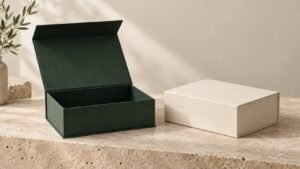
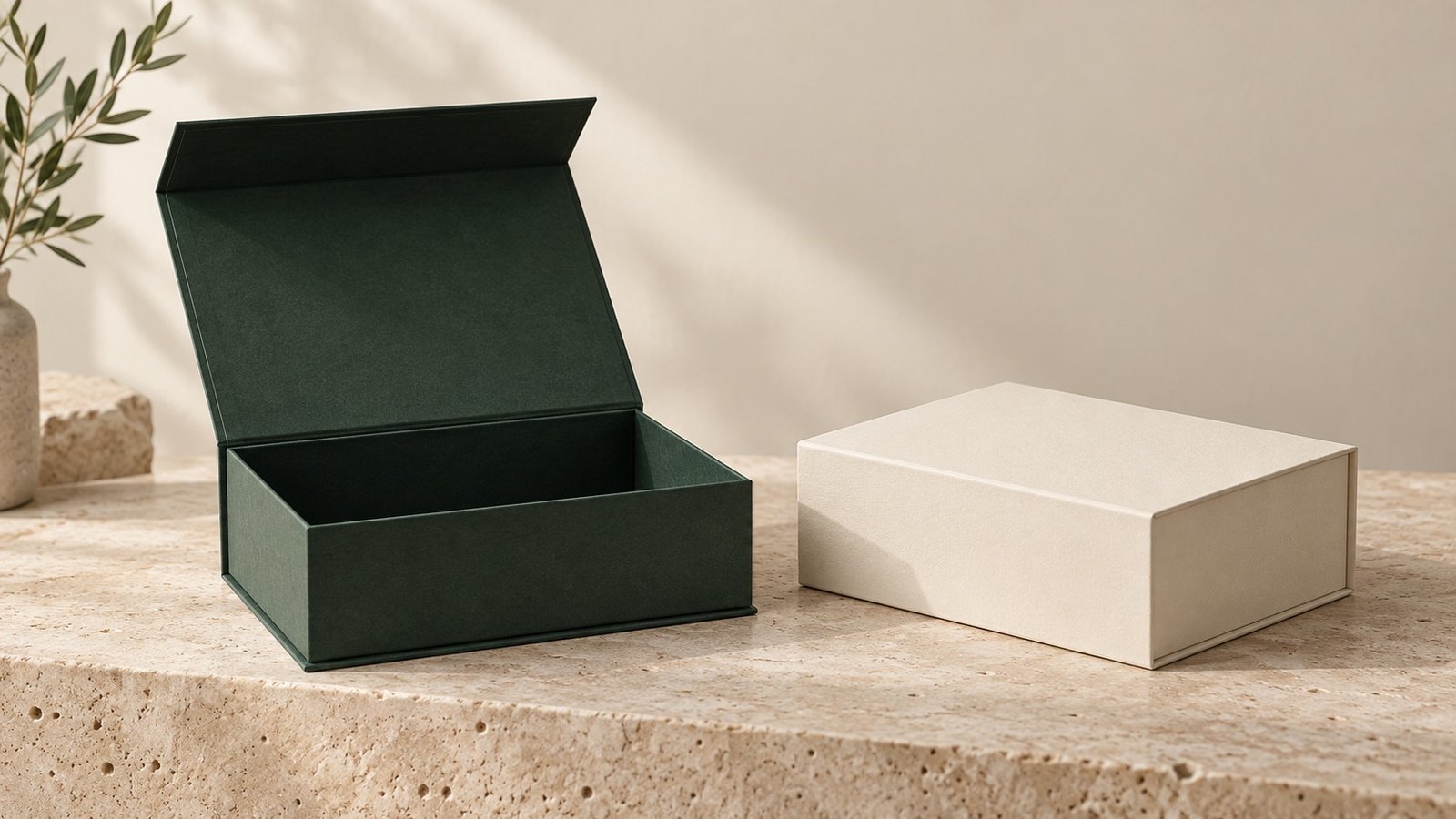
For most international orders, collapsible magnetic boxes are the better choice when freight volume, warehouse space and landed cost matter. Standard magnetic rigid boxes remain the stronger option when a brand wants the box to arrive fully formed, needs maximum dimensional consistency, or cannot add an assembly step. The right decision is therefore not simply “which box looks more premium?” Both can deliver an excellent unboxing experience. The real question is which structure fits your product, packing operation and distribution model.
This procurement guide compares custom collapsible rigid boxes with standard magnetic rigid boxes. It focuses on the details packaging buyers in the United States, Canada and Australia usually need before requesting a quotation: packed volume, assembly labor, board and magnet specifications, inserts, printing, testing, samples, production timing and DDP delivery.
Why This Comparison Matters Now: Current Search Data
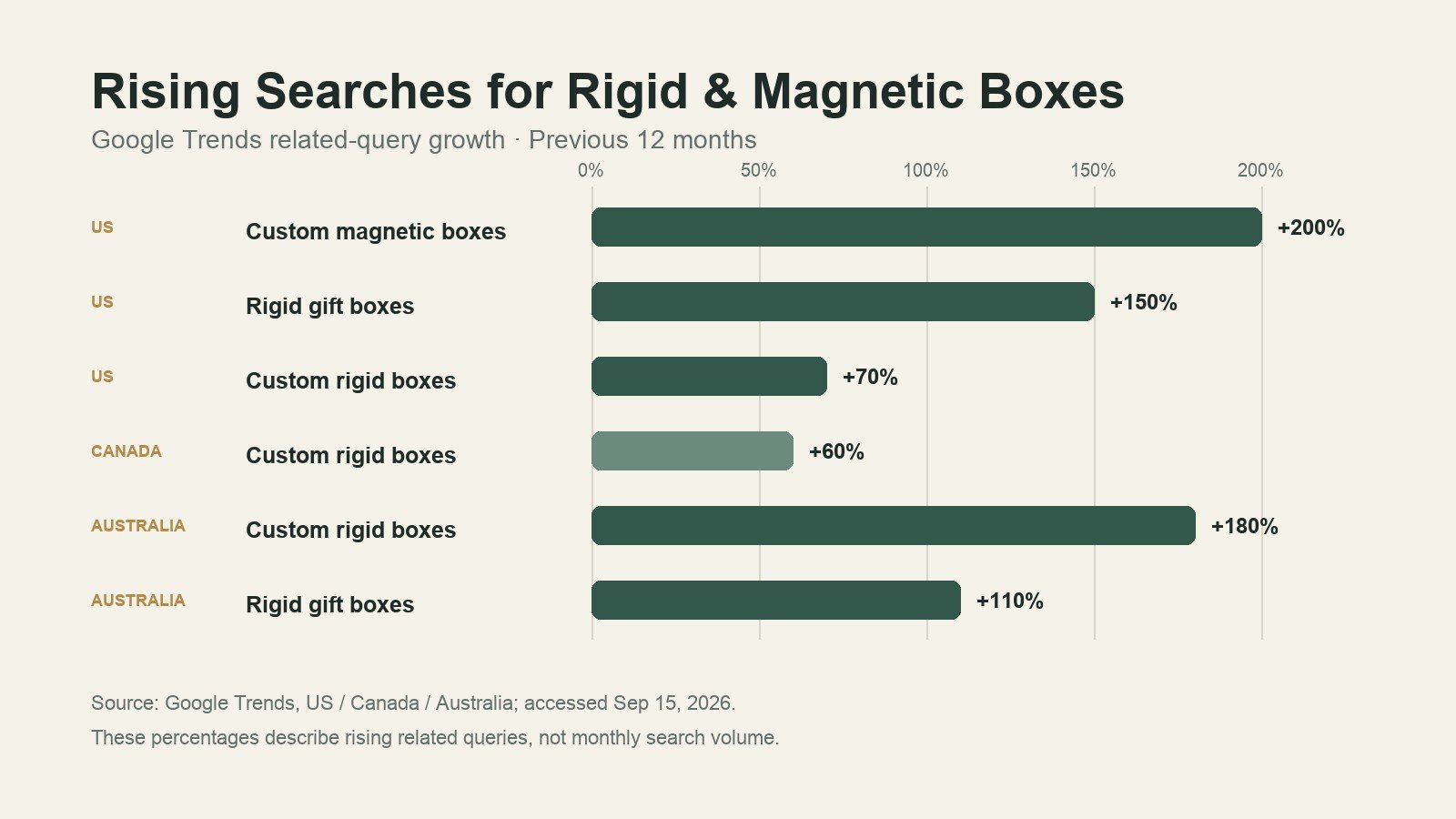
Buyer interest is moving toward more specific rigid-box structures. In Google Trends related-query data for the previous 12 months, “custom magnetic boxes” rose 200% in the United States, while “rigid gift boxes” rose 150% and “custom rigid boxes” rose 70%. “Custom rigid boxes” also rose 60% in Canada and 180% in Australia; “rigid gift boxes” rose 110% in Australia. These figures describe growth in related queries—not exact search volume—but they show that buyers are increasingly researching structure-specific packaging rather than only using the broad term “custom boxes.”
Quick recommendation
- Choose a collapsible magnetic box for international sourcing, seasonal inventory, subscription programs, e-commerce kits and projects where storage cube matters.
- Choose a standard magnetic rigid box for low-complexity packing, highly precise presentations, heavy contents or retail teams that want a ready-to-fill box.
- Compare both options using landed cost per usable box, not unit price alone.
Collapsible vs Standard Magnetic Boxes: Quick Comparison
| Buying factor | Collapsible magnetic box | Standard magnetic rigid box |
|---|---|---|
| Delivered form | Flat-packed; erected before filling | Fully formed and ready to fill |
| International freight volume | Usually lower, subject to final carton plan | Usually higher because every box ships at full volume |
| Warehouse space | Lower before assembly | Higher from arrival onward |
| Packing labor | Requires an erection step | No erection step |
| Structural consistency | Depends on hinge, adhesive and assembly quality | Excellent when manufactured correctly |
| Presentation | Premium after correct assembly | Premium immediately out of the carton |
| Best-fit programs | International, seasonal and space-sensitive programs | Ready-to-pack retail and precision presentation programs |
| Key risk | Poor assembly can create uneven corners | Shipping and storing empty volume |
What Is a Collapsible Magnetic Box?
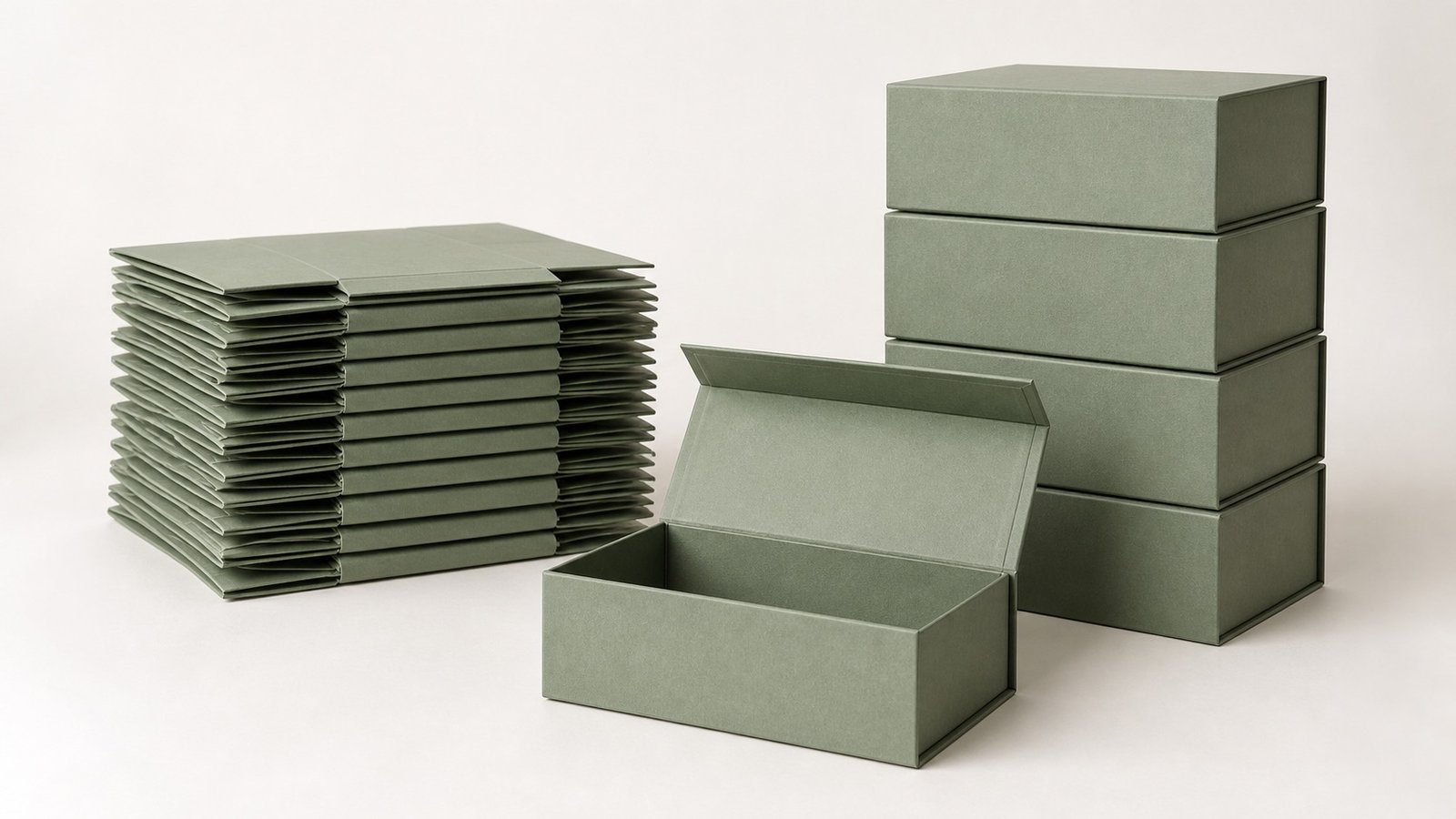
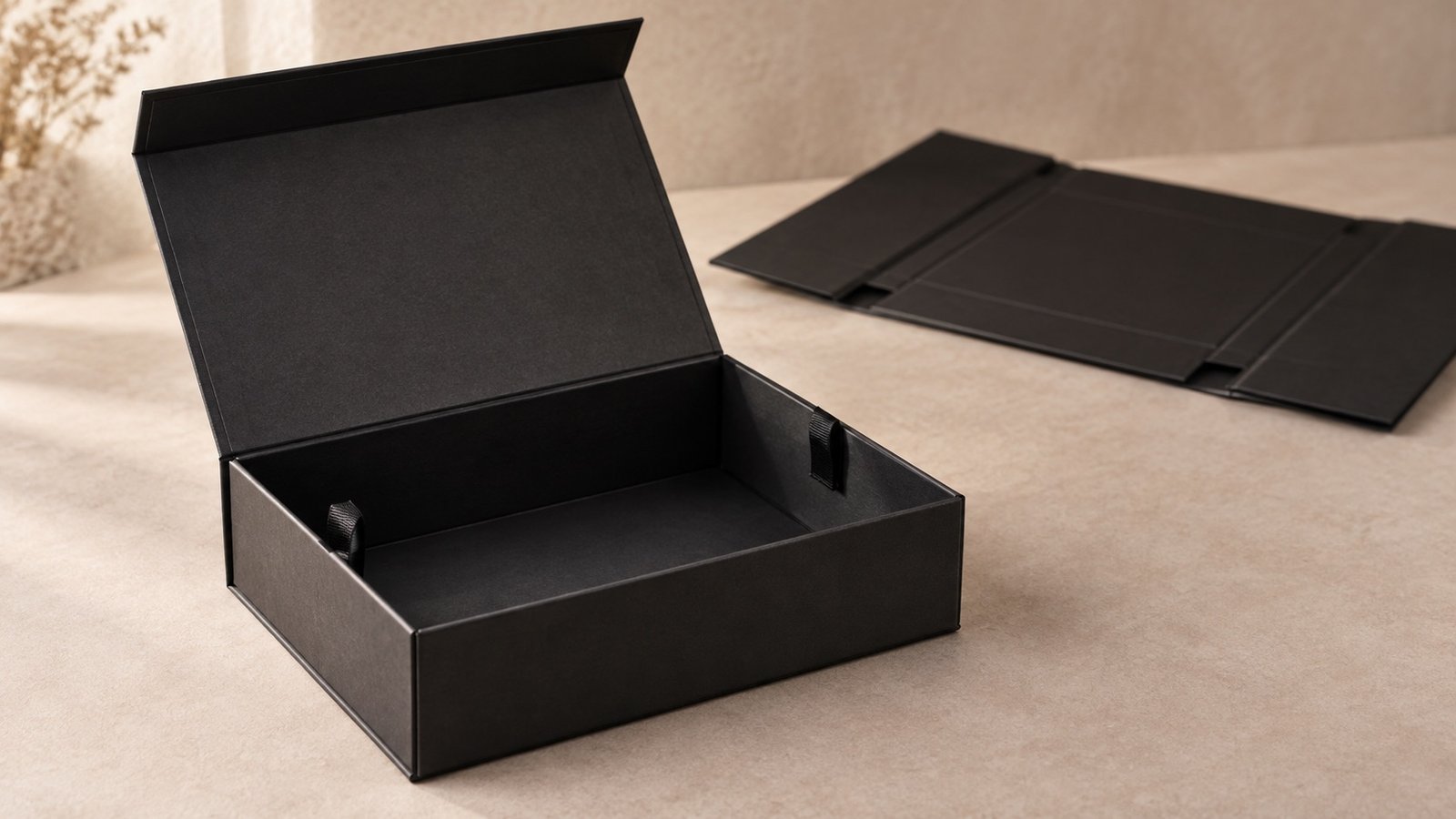
A collapsible magnetic box—also called a foldable magnetic gift box or flat-pack rigid box—is made from paper-wrapped rigid board with engineered hinge lines. Instead of being shipped as a permanent three-dimensional tray, its walls fold down for packing. During fulfillment, the user raises the side walls and secures the corners, commonly with concealed adhesive strips, locking tabs or pre-applied corner connections. Magnets inside the front flap and wall create the closing action.
It is still a rigid box. “Collapsible” describes how it is transported and stored, not how it feels after correct assembly. Board thickness, wrap paper, hinge design, corner system and manufacturing tolerances determine whether the finished box feels substantial or flimsy.
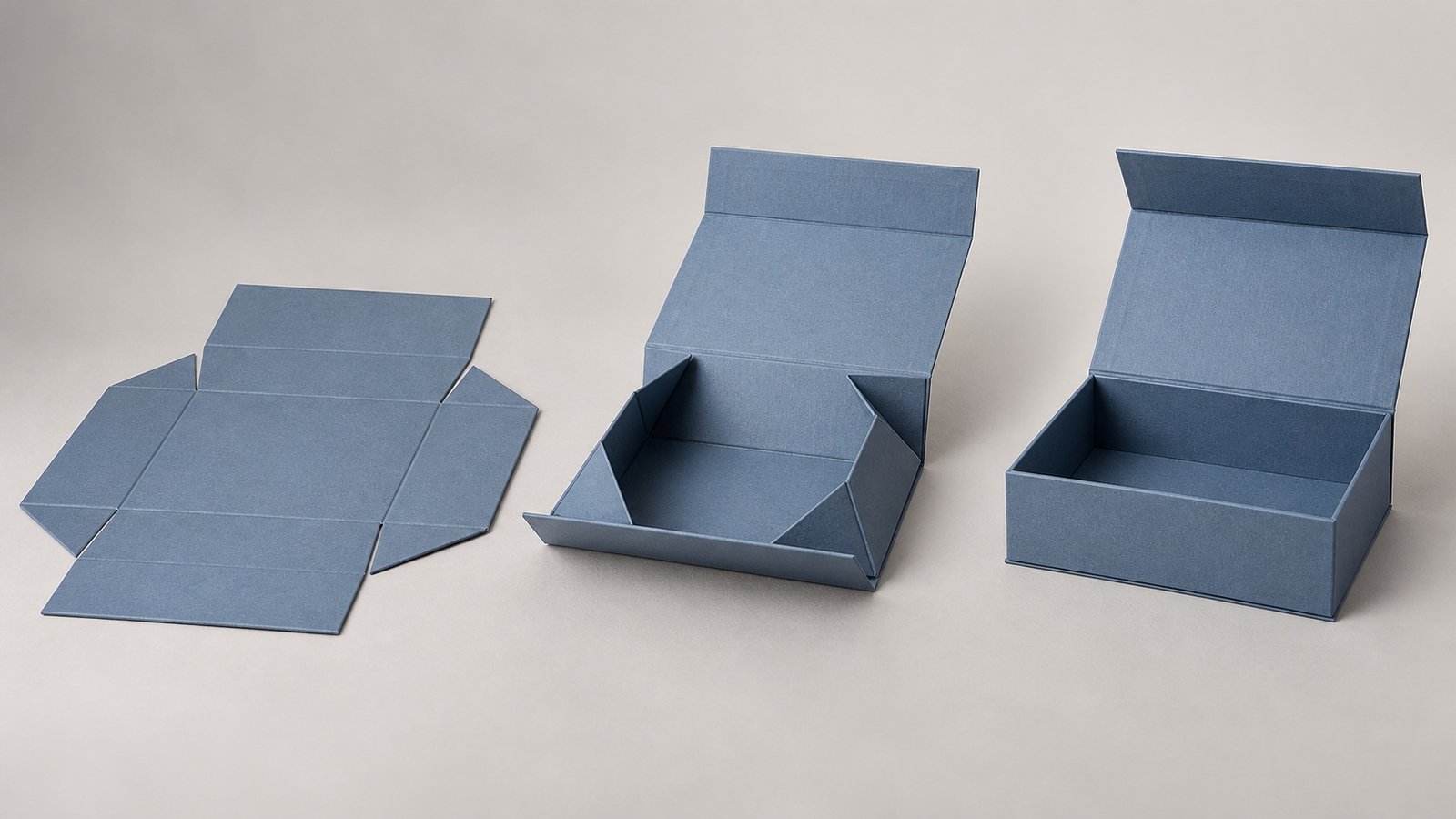
Buyers sometimes assume every foldable box is identical. In practice, two samples with the same external dimensions can perform very differently. One may square itself easily and hold its corners through repeated opening. Another may require force, expose adhesive, or develop a twisted lid. The physical sample is therefore a structural test, not only a color approval.
What Is a Standard Magnetic Rigid Box?
A standard magnetic rigid box is manufactured and delivered in its permanent shape. The base walls are already fixed, the hinged lid is attached, and the magnetic closure is aligned at the factory. The buyer can normally insert the product, add tissue or a card, close the lid and proceed to retail or fulfillment.
This format is valuable when assembly labor is unavailable or when presentation geometry must be extremely consistent. It is also easy to explain to a co-packer: every unit arrives ready to fill. The trade-off is cube. Empty boxes occupy their full three-dimensional volume throughout export packing, domestic transport and storage.
For other permanent constructions, review YiHongBox’s guide to custom rigid box types and the comparison of rigid boxes vs folding cartons.
The Most Important Cost Difference: Freight Cube
Rigid gift packaging is often relatively light for the space it occupies. This makes shipping volume a major cost driver. Parcel carriers describe this as dimensional or volumetric weight: the chargeable weight may be based on the package’s occupied space rather than its scale weight. FedEx, for example, explains that it charges according to actual weight or dimensional weight, whichever is greater, and publishes the formula on its dimensional-weight guidance.
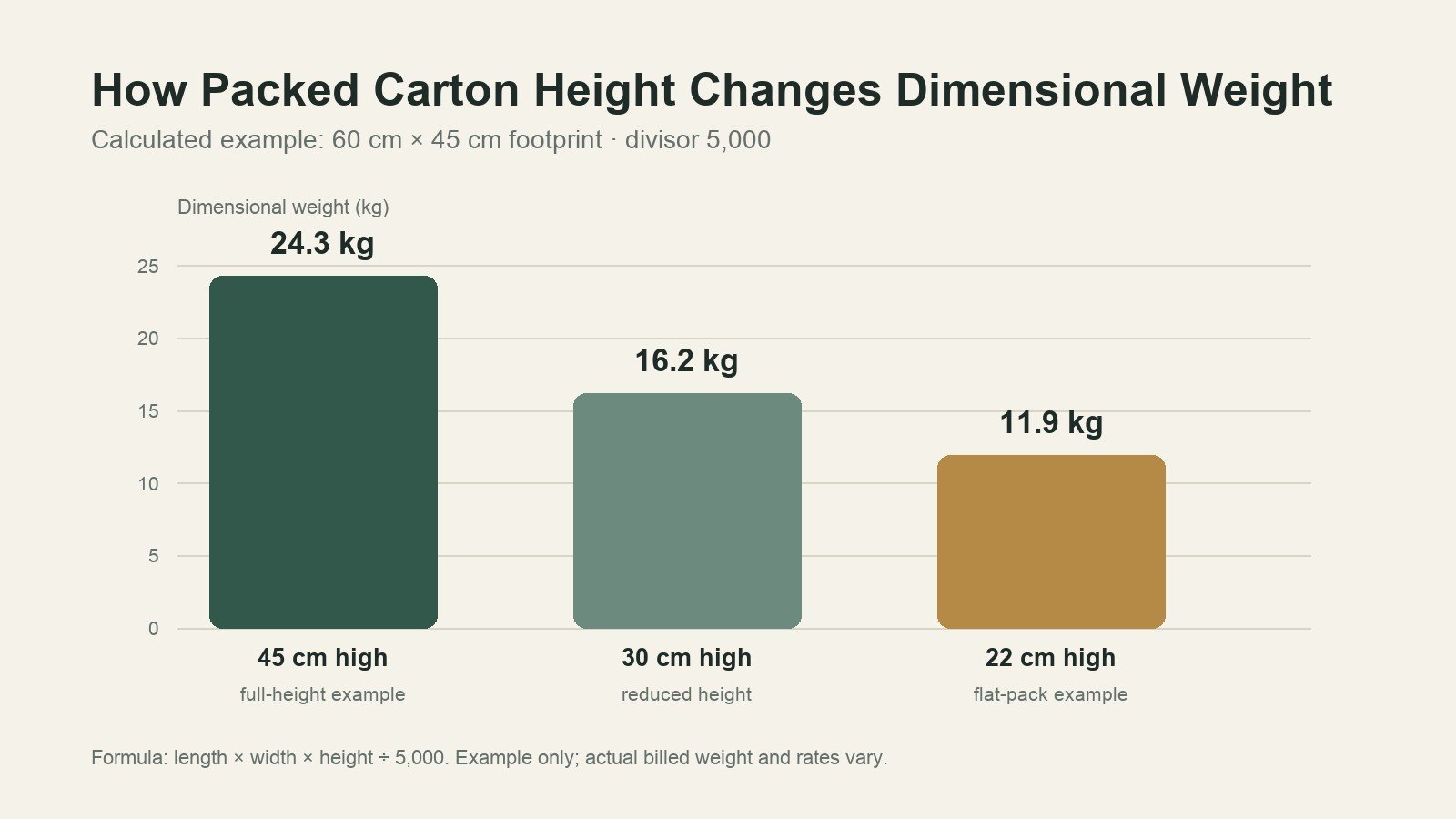
FedEx publishes a divisor of 5,000 for a metric dimensional-weight calculation. Using that formula, a 60 × 45 × 45 cm example carton produces 24.3 kg of dimensional weight. With the same length and width but a packed height of 22 cm, the calculated figure is 11.9 kg. This is a formula demonstration, not a freight quotation or a claim that every collapsible project will achieve that carton height.
| Example carton | Calculation | Dimensional weight |
|---|---|---|
| 60 × 45 × 45 cm | 121,500 ÷ 5,000 | 24.3 kg |
| 60 × 45 × 30 cm | 81,000 ÷ 5,000 | 16.2 kg |
| 60 × 45 × 22 cm | 59,400 ÷ 5,000 | 11.9 kg |
Ocean and consolidated freight quotations may be structured differently, but the procurement principle is the same: do not compare packaging quotations without comparing the export packing data behind them.
Ask every supplier for these five numbers
- Units per export carton
- Export-carton length, width and height
- Gross weight per carton
- Total number of cartons
- Total shipment volume in cubic meters
Calculate total volume rather than comparing statements such as “flat-pack saves freight.” For each carton:
Carton volume (m³) = length (m) × width (m) × height (m)
Then multiply by the carton count. If a quotation shows 4.8 m³ for a standard structure and 2.1 m³ for a collapsible version, the illustrative volume reduction is:
(4.8 − 2.1) ÷ 4.8 × 100 = 56.25%
This example is not a promised saving. Actual results depend on box dimensions, hinge construction, insert depth, protective interleaving, carton strength and pallet requirements. Your supplier should calculate the finished packing plan using the approved structure.
Do Not Ignore Assembly Labor
The freight advantage of a collapsible box is not free: somebody must erect it. A good structure can be opened, squared and secured quickly. A poor one can consume time through backing-paper removal, stubborn corners, trapped liners or repeated alignment.
Use a simple labor model:
Assembly cost per box = assembly seconds ÷ 3,600 × loaded hourly labor rate
For example, at 25 seconds per box, 1,000 boxes require approximately 6.9 labor hours before allowance for breaks, training or rejects. The relevant number is not the supplier’s demonstration time. Ask an untrained team member at your fulfillment location to assemble 20–30 sample boxes and record:
- median assembly time;
- slowest assembly time;
- corner or adhesive failures;
- percentage requiring rework;
- whether gloves are needed to avoid marks;
- whether the box remains square after 24 hours.
If your co-packer charges a separate touch fee for assembly, request that fee before approving the dieline. For automated or high-speed lines, a standard rigid box may be operationally simpler even when it occupies more freight space.
Structure, Magnets and Adhesive: What Buyers Should Specify
A premium-looking rendering does not define box quality. The purchase specification must describe the physical system. At minimum, confirm the following.
1. Rigid board thickness
Board should be selected according to box footprint, depth, product weight and expected handling. A larger box does not automatically become stronger by adding thicker board everywhere; hinge behavior, wall design and insert support also matter. Ask for the proposed thickness in millimeters and approve it on a physical sample.
2. Magnet configuration
Confirm magnet count, location and closure feel. Stronger is not always better. An aggressive closure can make the flap difficult to open, crush a delicate wrap paper or feel abrupt. A weak or poorly aligned pair makes the lid sit proud. Evaluate the closure with the actual insert and product loaded because the box geometry can change under weight.
3. Corner-securing method
Collapsible boxes may use peel-and-seal adhesive, pressure-sensitive tape, locking tabs or other engineered connections. Ask how the corner is fixed, whether adhesive has an application-temperature range, how long full bond develops, and how the release liner is removed. If the box will be assembled in a humid or cold environment, include those conditions in testing.
4. Hinge and crease quality
The wrap paper must bend repeatedly without cracking or exposing the board. Dark solid colors, heavily coated stocks and metallic papers deserve special attention because visible crease damage can undermine the luxury effect.
5. Squareness and lid alignment
Measure performance as an assembled system. Corners should meet cleanly, walls should stand upright, and the front flap should close without being pulled sideways. Approve acceptable tolerances with your supplier rather than relying on “industry standard” as an undefined phrase.
Which Box Protects the Product Better?
A standard rigid box generally begins with an advantage in dimensional consistency because its corners are permanently fixed. However, transport protection depends on the entire pack: rigid box, insert, product, retail sleeve if used, shipping carton, void fill and distribution channel. A beautiful gift box is not automatically a shipping box.
For individual parcel shipments, the International Safe Transit Association describes ISTA 3A as a general simulation test for packaged products moving through parcel delivery systems. ISTA also notes that testing should be reconsidered when the product, package, material, insert or closure changes. Select the protocol with a qualified testing partner based on the actual distribution route; do not place an ISTA mark on packaging unless the applicable licensing and review requirements are satisfied.
For a sourcing evaluation, start with practical checks:
- load the real product and leave the box closed for 24–72 hours;
- open and close the lid repeatedly;
- inspect paper at the hinge and corners;
- check whether the insert lifts, compresses or releases the product;
- place the retail box inside the proposed shipping carton and test the complete pack;
- repeat the test after any material or structural change.
Custom Inserts Matter More Than Box Type
In many projects, the insert does more to control product movement than the rigid shell. The insert should support the product at strong points, protect decorated surfaces and create enough finger clearance for removal.

Common options include:
- Folded paperboard inserts: printable, versatile and often easy to flatten for disposal.
- Molded pulp: useful for sculpted support and a visibly fiber-based presentation.
- EVA or PE foam: precise and resilient, especially for electronics, tools and fragile accessories, but it changes the material and recycling discussion.
- Fabric-covered board or foam: appropriate for jewelry, watches and premium keepsakes where tactile presentation is central.
- Thermoformed trays: precise and clean, but resin choice, local recovery systems and sustainability claims require careful review.
Send dimensioned product drawings or physical product samples whenever possible. For bottles and jars, include the cap, pump and filled weight. For sets, define the removal sequence so customers do not have to pull one product out to reach another.
Printing and Finishes: Both Structures Can Look Premium
Collapsible does not mean visually basic. Both structures can support colored wrap paper, litho-printed sheets, hot foil stamping, embossing, debossing, spot UV, textured papers and interior printing. Explore YiHongBox’s packaging materials and design sourcing guide when building the specification.
The best finish depends on handling:
- Dark soft-touch surfaces look dramatic but may show fingerprints or rub marks.
- Foil needs adequate clearance from edges, hinges and deep creases.
- Fine uncoated paper communicates tactility but may absorb color differently from coated stock.
- Large solid printed areas make color variation and scuffing more visible.
- Embossing and debossing must be coordinated with board construction and magnet positions.
Approve color under controlled lighting and keep a signed reference sample. A screen proof can confirm layout, but it cannot fully predict paper color, foil reflectivity, texture, crease behavior or the sound and pull of the magnetic closure.
Best Applications for Each Structure
Collapsible magnetic boxes are usually well suited to:
- beauty and skincare gift sets;
- apparel, scarves and accessories;
- influencer and public-relations kits;
- subscription and seasonal campaigns;
- corporate gifting distributed across multiple regions;
- brands importing empty packaging before local fulfillment.

Standard magnetic rigid boxes are usually well suited to:
- watches, jewelry and high-value accessories;
- heavy products requiring permanently fixed walls;
- retail programs with limited assembly labor;
- short packing windows where every handling step matters;
- presentation kits where dimensional precision is the top priority;
- programs that ship the product and box together from the manufacturing origin.
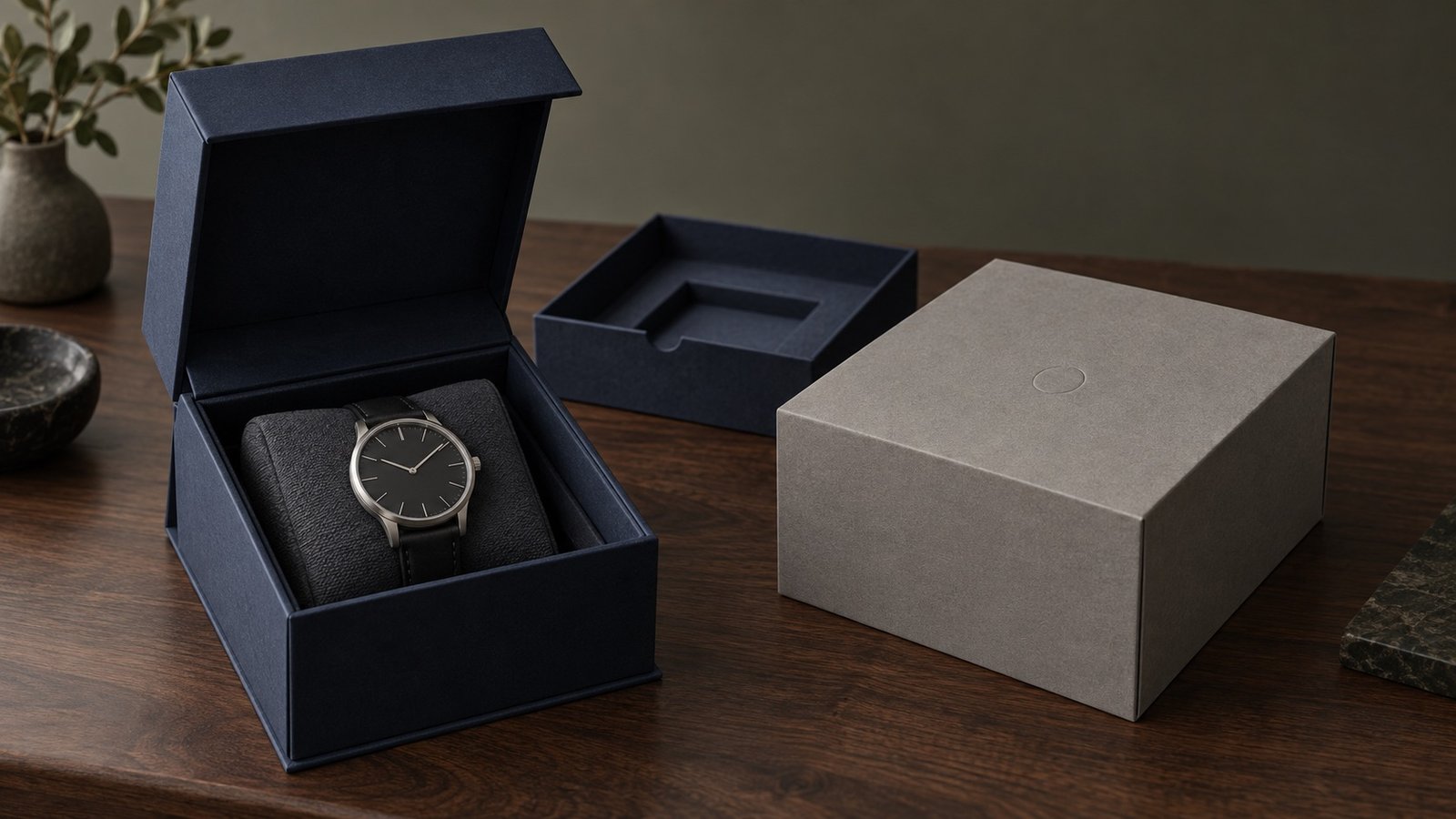
These are starting points, not rules. A well-engineered collapsible box can hold a watch, and a standard box can package skincare. The decision should follow a prototype packed with the real product.
How to Compare Landed Cost Correctly
Unit price is only one line in the purchasing decision. Compare:
- box manufacturing cost;
- insert and accessory cost;
- export cartons and protective packing;
- freight and destination delivery;
- duties and taxes where applicable;
- customs or brokerage charges;
- warehouse space;
- assembly and packing labor;
- expected damage and rework;
- disposal or recovery requirements.
For projects quoted DDP, define the named destination precisely. Under the ICC’s Delivered Duty Paid rule, the seller carries a high level of responsibility, including import clearance and applicable duties and taxes, to the named destination. Buyers should still confirm what the commercial quote includes: unloading, appointments, remote-area surcharges, storage caused by buyer delay and any services after arrival.
A useful request is: “Please quote the same approved box specification in both collapsible and standard magnetic structures, showing EXW unit price, packing data and DDP total to our exact postcode.” This separates structural economics from changes in paper, board, finish or insert.
Sustainability: Make Specific, Supportable Claims
Flat packing can reduce transport and storage volume, but that does not by itself prove that the complete package is “eco-friendly.” Material origin, adhesives, magnets, laminations, inserts, reuse and local recycling systems all matter. The U.S. Environmental Protection Agency places source reduction and reuse high in its materials-management hierarchy.
For the U.S. market, the Federal Trade Commission advises marketers to avoid broad, unqualified environmental-benefit claims and to explain specific benefits clearly. Its Green Guides summary also explains that source-reduction comparisons should identify the amount reduced and the basis of comparison.
In practice, a buyer can request certified paper options, document recycled-content percentages when used, minimize unnecessary components, and describe measurable changes such as reduced packed volume against a named previous structure. If FSC claims or trademarks will appear on the box, confirm chain-of-custody and artwork approval requirements before printing.
Sampling and Production Plan
YiHongBox provides free structural and artwork design support; physical samples are charged. A typical custom sample requires about seven days after the structure, artwork and materials are confirmed. Mass production is normally planned at about 30 days after sample approval and deposit, subject to quantity, finishes, materials and production schedule.
For a useful sample review, request:
- the exact box structure and dimensions;
- the proposed board and wrap paper;
- actual magnet and corner construction;
- an insert made around the real product or accurate dummy;
- representative printing and finishes;
- a flat sample plus an assembled reference for collapsible projects;
- export-carton packing data based on the approved sample.
Do not approve only the attractive face of the box. Inspect the back hinge, inner corners, release liners, exposed edges, magnet alignment, lid gap and insert removal. Photograph the signed sample and record revisions in writing.
RFQ Checklist for Packaging Buyers
To receive a comparable quotation, send the same information to every supplier:
- box style: collapsible magnetic or standard magnetic rigid;
- finished internal dimensions in L × W × H;
- product dimensions and weight;
- order quantity and expected annual volume;
- wrap paper, color and finish requirements;
- logo size and process;
- insert material and product layout;
- accessories such as ribbon, card or sleeve;
- destination country, postcode and delivery type;
- requested Incoterm, including the exact DDP named place;
- required delivery date;
- testing or compliance requirements;
- carton marks and labeling requirements.
YiHongBox’s standard minimum order quantity for these custom projects is 1,000 pieces. Buyers can review more custom rigid box options, browse custom packaging products, or compare a different structure in the E-flute vs B-flute mailer box guide.
Request Both Structures in One Quote
Send your product size, box dimensions, quantity, artwork and destination postcode. YiHongBox can prepare a side-by-side recommendation for a collapsible magnetic box and a standard magnetic rigid box, including packing data and DDP options for the United States, Canada or Australia.
Frequently Asked Questions
Are collapsible magnetic boxes as premium as standard rigid boxes?
They can be. After correct assembly, a well-engineered collapsible magnetic box can provide rigid walls, a controlled magnetic close and premium printing. Quality depends on board, paper, hinges, adhesive, magnet alignment and assembly—not the word “collapsible.”
Do collapsible magnetic boxes always reduce shipping cost?
No. They usually reduce packed volume, but freight cost depends on the final carton plan, weight, route, carrier, shipment mode and destination. Compare total cartons, cubic meters, gross weight and the complete freight quotation.
How long does it take to assemble a foldable magnetic box?
It varies by size and corner system. Test 20–30 physical samples with the actual packing team and use the median time in your labor model. Include liner removal, squaring, insert placement and rework.
Will the adhesive corners open after assembly?
They should not when the adhesive, surface and assembly process are correctly matched. Ask about bond development, storage conditions and application temperature, then test assembled samples under the expected environment and product load.
Can foldable magnetic gift boxes use custom inserts?
Yes. Paperboard, molded pulp, foam, fabric-covered and thermoformed inserts are possible. Insert depth and packing method may affect how flat the overall set can ship, so confirm whether inserts will be nested, packed separately or preinstalled.
Which option is better for heavy products?
A standard rigid box is often the safer starting point, but weight alone does not decide the structure. Board, base design, corner connection, insert support and handling route must be evaluated with the loaded product.
Can both structures use foil stamping and embossing?
Yes. Both can support premium finishes. Artwork must keep critical details away from hinges, folds, magnet positions and wrapped edges, and a physical sample should confirm the result.
What is the MOQ for custom magnetic boxes?
YiHongBox’s standard MOQ is 1,000 pieces for custom collapsible and standard magnetic rigid box projects.
How long do sampling and mass production take?
A custom physical sample typically takes about seven days after details are confirmed. Mass production is normally planned at about 30 days after approval and deposit, depending on specification and schedule.
Is packaging design free?
YiHongBox provides free structural and artwork design support. Physical samples are charged because they require materials, setup, printing and hand finishing.
Can YiHongBox deliver DDP to the United States, Canada and Australia?
Yes, DDP options are available for these markets. Provide the exact postcode, delivery address type, quantity and deadline so the quotation can define the named destination and included services.
What should I send to receive an accurate quote?
Send the product dimensions and weight, internal box size, quantity, artwork, desired paper and finishes, insert requirements, destination postcode and delivery deadline. Product photos or a physical sample also improve insert accuracy.
Final Decision
Choose a collapsible magnetic box when its reduction in freight and storage cube is greater than the added assembly and process cost. Choose a standard magnetic rigid box when ready-to-fill handling, permanent geometry and presentation control are worth the additional cube. For many international packaging programs, the best purchasing decision comes from sampling both structures and comparing their landed cost using one identical product brief.
Ready to compare? Request a quote from YiHongBox with your product dimensions, quantity and destination postcode. We will help evaluate the box structure, insert and DDP packing plan before production.